This fictional vision of slavery was pervasive many years after the war, up to and including GWTW. In her book Clinging to Mammy (2007), Micki McElya posits the idea that “the myth of the faithful slave lingers because so many white Americans have wished to live in a world in which African Americans are not angry over past and present injustices, a world in which white people were and are not complicit, in which the injustices themselves—of slavery, Jim Crow, and ongoing structural racism—seem not to exist at all.”.
Subscribe to Rosanne’s Channel and receive notice of each new video!
Transcript:
So now, in reading screenplays, people can appreciate the voice of the writer in a way they were never able to before. So we see this movement going on which is very important to me. Again, why does this matter? Because we stand on the shoulders of all the people who came before us in this business. We owe them understanding who they are and what they had to offer. In my mind, we have to honor them the same way he honors his ancestors in this movie. That’s what we’re all about if you ask me. So when i teach in this program, this is why these words mean something to me. WRITE, so you can REACH other people and REPRESENT the cultures and the stories that have not been told before. That, to me, is something that we should be very excited about. That’s why researching screenwriters has always mattered. I’m Rosanne Welch I approve this message. Thank you very much.
Watch this entire presentation
A Note About This Presentation
A clip from my keynote speech at the 10th Screenwriters´(hi)Stories Seminar for the interdisciplinary Graduation Program in “Education, Art, and History of Culture”, in Mackenzie Presbyterian University, at São Paulo, SP, Brazil, focused on the topic “Why Researching Screenwriters (has Always) Mattered.” I was especially pleased with the passion these young scholars have toward screenwriting and it’s importance in transmitting culture across the man-made borders of our world.
To understand the world we have to understand its stories and to understand the world’s stories we must understand the world’s storytellers. A century ago and longer those people would have been the novelists of any particular country but since the invention of film, the storytellers who reach the most people with their ideas and their lessons have been the screenwriters. My teaching philosophy is that: Words matter, Writers matter, and Women writers matte, r so women writers are my focus because they have been the far less researched and yet they are over half the population. We cannot tell the stories of the people until we know what stories the mothers have passed down to their children. Those are the stories that last. Now is the time to research screenwriters of all cultures and the stories they tell because people are finally recognizing the work of writers and appreciating how their favorite stories took shape on the page long before they were cast, or filmed, or edited. But also because streaming services make the stories of many cultures now available to a much wider world than ever before.
Many thanks to Glaucia Davino for the invitation.
* A portion of each sale from Amazon.com directly supports our blogs ** Many of these books may be available from your local library. Check it out! † Available from the LA Public Library
I had a lot of fun on my first Twitter Chat last Sunday. Jeanne Veillette Bowerman of #Scriptchat had invited to talk about how to behave in a writers room alongside what are the benefits of an MFA in TV and Screenwriting (such as the one we offer from Stephens College).
Happily, I had just interviewed Gloria Calderon Kellet who had an MFA and who had said so astutely that no one requires that in Hollywood but taking 2 years to invest in herself and her craft meant she had material that was truly of high enough quality to offer up when future producers offered to read her work. So that was nice!
As to Twitter, I knew being short and concise is the bread and butter of Twitter but… wow… I’m clearly a much longer storyteller and kept running over the limit and having to use ellipses to extend a sentence or a thought. But folks seemed to enjoy it and even said I had ‘dropped pearls’ so that was nice to hear as well.
Check out #Scriptchat every Sunday night at 5pmPST/8pmET for more fun guests.
“Where’s HER Movie” posts will highlight interesting and accomplished women from a variety of professional backgrounds who deserve to have movies written about them as much as all the male scientists, authors, performers, and geniuses have had written about them across the over 100 years of film. This is our attempt to help write these women back into mainstream history. — Rosanne
Anna LoPizzo was a striker killed during the Lawrence Textile Strike (also known as the Bread and Roses Strike), considered one of the most significant struggles in U.S. labor history. Eugene Debs said of the strike, “The Victory at Lawrence was the most decisive and far-reaching ever won by organized labor.”[1] Author Peter Carlson saw this strike conducted by the militant Industrial Workers of the World (IWW) as a turning point. He wrote, “Wary of [a war with the anti-capitalist IWW], some mill owners swallowed their hatred of unions and actually invited the AFL to organize their workers.[2]
Anna LoPizzo’s death was significant to both sides in the struggle. Wrote Bruce Watson in his epic Bread and Roses: Mills, Migrants, and the Struggle for the American Dream, “If America had a Tomb of the Unknown Immigrant paying tribute to the millions of immigrants known only to God and distant cousins compiling family trees, Anna LoPizzo would be a prime candidate to lie in it.”[3] — Wikipedia
I enjoyed sharing the names and careers of women like Peg Lynch, Gerturde Berg, Selma Diamond and D.C. Fontana to the members who gathered on Zoom last Wednesday morning. There are so many more I could have talked about whose names don’t appear in mainstream books about the history of television so we have to learn who they are and carry those names forward ourselves. It’s one of the missions of the Stephens College MFA in TV and Screenwriting – and has been one of my missions all my life.
Women pioneers who created, produced or shepherded many of America’s most wildly popular, early television programs will be profiled by Dr. Rosanne Welch.
In this clip from a recent Starcatcher podcast film professor (and MFA alum) and host – Chase Thompson – interviews Tech Theatre professor (and MFA alum) Michael Blake about their time as MFA candidates in our Stephens College MFA in TV and Screenwriting program.
They both mention the great feedback they received from their writing mentors, which made me thankful for the dedication of the many marvelous mentors in our program. Then the part that made me smile the most… They each reflected on how important it was in the History of Screenwriting courses to learn about all the female screenwriters who founded Hollywood and how often those women were left out of mainstream histories of the era.
It’s a very powerful example of how history takes time — and deep research — or someone(s) will be left out.
Join me for a conversation with Stephens College’s Director of Production, Michael Burke. A former graduate of the Stephens Theatre program, Michael talks about his path to production, his background, why Theatre majors are so good at saying thank you, and his predictions on where the road Theater is heading after the pandemic is over.
Highlighting the articles in the past editions of the Journal of Screenwriting, of which I am the Book Reviews Editor. Hopefully these abstracts will entice you to did a little deeper into the history and future of screenwriting. — Rosanne
The aim of this article is to examine how the writer, through the means of the screenplay text, communicates the potential film to the reader. The article argues that the screenplay text’s reason for existing is to communicate the potential film, and that analysing a screenplay text through a communicational approach therefore is suitable. The author will ask what type of information is communicated, who it is that communicates and how the communication appears in the text. The article will propose a model that displays the different narrating voices that can be found in screenplay texts, and a set terminology for the narrating voices that clearly position them in relation to the text and the information they provide will be proposed. The examination of extracts from published screenplays further enables the author to identify how the use of the different narrating voices situates the reader at a certain distance from the story.
The Journal of Screenwriting is an international double-blind peer-reviewed journal that is published three times a year. The journal highlights current academic and professional thinking about the screenplay and intends to promote, stimulate and bring together current research and contemporary debates around the screenplay whilst encouraging groundbreaking research in an international arena. The journal is discursive, critical, rigorous and engages with issues in a dynamic and developing field, linking academic theory to screenwriting practice.
The criticism GWTW engendered then and now center on the omission of any real depiction of the horrors of slavery. Outside of Scarlett slapping Prissy on the day the maid admits knowing nothing about childbirth (despite bragging about her expertise for weeks), none of the major characters ever mistreats a slave. Critics might fault Mitchell for not doing enough historical research before undertaking the story, but Mitchell was writing from the only perspective she had been taught, the myth of the benevolent slave master, not from the perspective of an enslaved main character. Still, this first error of omission is the most blatant error.
Subscribe to Rosanne’s Channel and receive notice of each new video!
Transcript:
…And that’s very important why, when we’re teaching screenwriting — It’s funny. People who come from a directing background like to teach that writers shouldn’t “direct on the page.” Don’t say things about where the camera should go. Don’t say how the actor is feeling. Don’t talk casually. But in fact, most of the screenwriters who sell and win Oscars are people whose voice is so recognizable. Aaron Sorkin sounds like Aaron Sorkin in everything he does. Every single piece of action is as if you are sitting there talking to him. Right? William Goldman did that. most of the big names — Nora Ephron — who was a major American female screenwriter. Their personality comes through in the lines and they do tell the director “I need this. I need this closeup. I want this moment. This is exactly what needs to happen here. Those are the screenplays that do sell because a person at a studio has to read the thing and envision the movie. If they don’t see it. They don’t buy it and they don’t make it. So that piece of advice has never worked for me.
Watch this entire presentation
A Note About This Presentation
A clip from my keynote speech at the 10th Screenwriters´(hi)Stories Seminar for the interdisciplinary Graduation Program in “Education, Art, and History of Culture”, in Mackenzie Presbyterian University, at São Paulo, SP, Brazil, focused on the topic “Why Researching Screenwriters (has Always) Mattered.” I was especially pleased with the passion these young scholars have toward screenwriting and it’s importance in transmitting culture across the man-made borders of our world.
To understand the world we have to understand its stories and to understand the world’s stories we must understand the world’s storytellers. A century ago and longer those people would have been the novelists of any particular country but since the invention of film, the storytellers who reach the most people with their ideas and their lessons have been the screenwriters. My teaching philosophy is that: Words matter, Writers matter, and Women writers matte, r so women writers are my focus because they have been the far less researched and yet they are over half the population. We cannot tell the stories of the people until we know what stories the mothers have passed down to their children. Those are the stories that last. Now is the time to research screenwriters of all cultures and the stories they tell because people are finally recognizing the work of writers and appreciating how their favorite stories took shape on the page long before they were cast, or filmed, or edited. But also because streaming services make the stories of many cultures now available to a much wider world than ever before.
Many thanks to Glaucia Davino for the invitation.
* A portion of each sale from Amazon.com directly supports our blogs ** Many of these books may be available from your local library. Check it out! † Available from the LA Public Library
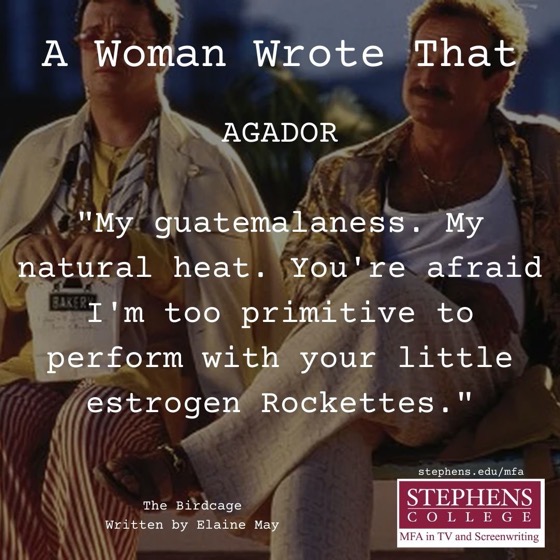
This new “A Woman Wrote That” post is an echo of the Writers Guild campaign of a few years ago (“A Writer Wrote That”) where they noted famous movie quotes and credited the screenwriter rather than the director. The difference here being that we will be posting lines from films written by female screenwriters. Feel free to share! — Rosanne
AGADOR
“My guatemalaness. My natural heat. You’re afraid I’m too primitive to perform with your little estrogen Rockettes.”

![49 Appreciating The Voice Of The Writer from Why Researching Screenwriters Has Always Mattered [Video] (1 minute 2 seconds)](https://rosannewelch.com/wp-content/uploads/2021/02/rmw-sao-paolo-49.png)


![Dr. Rosanne Welch Speaks On “VISIBLE STARS: Women in Early TV” for the American Women Writers National Museum [Video] (26 minutes)](https://rosannewelch.com/wp-content/uploads/2021/01/RMW-Rosanne-Signature-for-Web.png)


![Stephens College MFA Alumni Chase Thompson and Michael Burke Talk About Their MFA Experience on the Starcatcher Podcast [Audio Except]](https://rosannewelch.com/wp-content/uploads/2021/02/starcatcher-106-burke-mfa.jpg)

![48 Directing On The Page from Why Researching Screenwriters Has Always Mattered [Video] (1 minute 3 seconds)](https://rosannewelch.com/wp-content/uploads/2021/02/rmw-sao-paolo-48.png)