From The Journal Of Screenwriting V4 Issue 3: Bridges and gaps: The Singing Detective’s serial afterlife by Sean O’Sullivan

Highlighting the articles in the past editions of the Journal of Screenwriting, of which I am the Book Reviews Editor. Hopefully these abstracts will entice you to did a little deeper into the history and future of screenwriting. — Rosanne


Bridges and gaps: The Singing Detective’s serial afterlife by Sean O’Sullivan

The Singing Detective has long been considered a high point of televisual storytelling. But what is its specific legacy as a serial narrative, particularly in the contemporary U.S. context of ambitious dramas? In many ways, the experiment of The Singing Detective remains an outlier. If the likes of Mad Men and The Sopranos have re-invigorated seriality by emphasizing the gaps between episodes—by making the narrative broken rather than connected—The Singing Detective’s continuing contribution lies in its insistence on bridging the disparate parts that make a serial: old and new, sound and image, memory and imagination, ritual and eccentricity.

From The Journal Of Screenwriting V4 Issue 3: Bridges and gaps: The Singing Detective’s serial afterlife by Sean O’Sullivan


Journal of Screenwriting Cover

The Journal of Screenwriting is an international double-blind peer-reviewed journal that is published three times a year. The journal highlights current academic and professional thinking about the screenplay and intends to promote, stimulate and bring together current research and contemporary debates around the screenplay whilst encouraging groundbreaking research in an international arena. The journal is discursive, critical, rigorous and engages with issues in a dynamic and developing field, linking academic theory to screenwriting practice. 

Get your copy and subscription to the Journal of Screenwriting Today!


* A portion of each sale from Amazon.com directly supports our blogs
** Many of these books may be available from your local library. Check it out!

The Civil War On Film – 28 in a series – “…except for them it was a conflict of beliefs.”

The Civil War On Film - 28 in a series -

In terms of the American Civil War, the Friends experienced the same conflicts of brother against brother that infused the North and the South, except for them it was a conflict of beliefs. They had declared their adamant opposition to the importation of slaves as early as 1696 at their Society of Friends (Quaker) Yearly Meeting. As slavery took hold of the South anyway, many became fervent abolitionists willingly breaking the law to aid enslaved people on their escapes via the Underground Railroad.

Movies profiled in this book:

09 More on Stephen J. Cannell from How The Chaos Of Collaboration in the Writers Room Created Golden Age Television [Video]

With the full recording of “How The Chaos Of Collaboration in the Writers Room Created Golden Age Television”

09 More on Stephen J. Cannell from How The Chaos Of Collaboration in the Writers Room Created Golden Age Television [Video]

Subscribe to Rosanne’s Channel and receive notice of each new video!


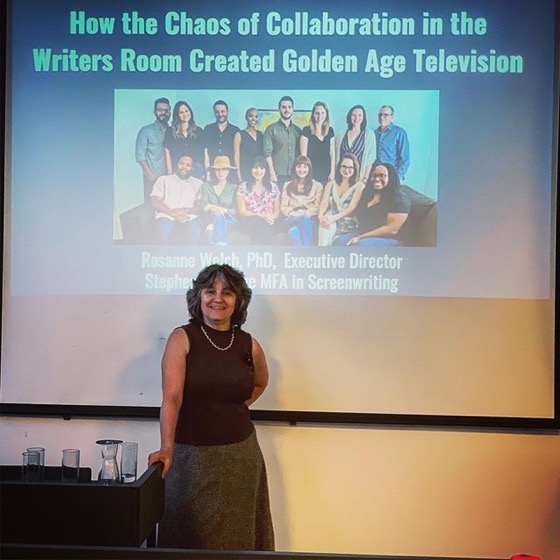
When the folks hosting the conference announced their theme as “Screen Narratives: Chaos and Order” the word ‘chaos’ immediately brought to mind writers rooms. I offered a quick history of writers rooms (the presentations are only 20 minutes long) and then quoted several current showrunners on how they compose their rooms and how they run them.

Transcript

I was able to interview a certain set of these men — actually, Stephen Cannell in the year before he died — to talk about their time at Universal and the transition from this pool into their own rooms and how they would comprise those rooms. again, all these men that I just mentioned are famous because of what they came up with. Cannel is someone we know from many action-adventure television shows. When he passed away the show, Castle, which was big in the United States — the men who worked on that show had been in his writer’s pools early in their career. So, he was famous for this ending on his show where he would type in the typewriter and pull the paper out — that was his brand. At the end of this show, Castle, which he did not work on. they gave this — colleague, mentor, friend ending — in tribute to him. So that’s how important he was to their careers. They learned how to run their own rooms from working with him. These are all the shows that we know him from at some point or another. So he’s certainly a man with a very distinct style that stood out for a long time.

For more information on the Screenwriting Research Network, visit

Screenwriting Research Network Conference, Porto, Portugal, All Sessions


Ready to present my talk yesterday at the Screenwriting Research Conference here in Porto, Portugal via Instagram

Follow me on Instagram


* A portion of each sale from Amazon.com directly supports our blogs
** Many of these books may be available from your local library. Check it out!

Screenwriting Question #3 : Act lengths in TV scripts via TikTok [Video]

@drrosannewelch

##Screenwriting ##Question ##3: ##Act ##lengths in ##TV ##scripts ##screenwriting

♬ original sound – Dr. Rosanne Welch


Screenwriting Question #3 : Act lengths in TV scripts via TikTok [Video]


Read more about screenwriting with these books

* A portion of each sale from Amazon.com directly supports our blogs
** Many of these books may be available from your local library. Check it out!
† Available from the LA Public Library

Where’s Her Movie? Activist, Dolores Huerta – 17 in a series

“Where’s HER Movie” posts will highlight interesting and accomplished women from a variety of professional backgrounds who deserve to have movies written about them as much as all the male scientists, authors, performers, and geniuses have had written about them across the over 100 years of film.  This is our attempt to help write these women back into mainstream history.  — Rosanne

Where's Her Movie? Activist, Dolores Huerta  - 17 in a series

Dolores Clara Fernández Huerta (born April 10, 1930) is an American labor leader and civil rights activist who, with Cesar Chavez, is a co-founder of the National Farmworkers Association, which later merged with the Agricultural Workers Organizing Committee to become the United Farm Workers (UFW).[1] Huerta helped organize the Delano grape strike in 1965 in California and was the lead negotiator in the workers’ contract that was created after the strike.[2]

Huerta has received numerous awards for her community service and advocacy for workers’, immigrants’, and women’s rights, including the Eugene V. Debs Foundation Outstanding American Award, the United States Presidential Eleanor Roosevelt Award for Human Rights[3] and the Presidential Medal of Freedom.[4] She was the first Latina inducted into the National Women’s Hall of Fame, in 1993.[5][6]

Huerta is the originator of the phrase, “Sí, se puede“.[7] As a role model to many in the Latino community, Huerta is the subject of many corridos (Mexican or Mexican-American ballads) and murals.[8]

In California, April 10 is Dolores Huerta Day.[9]  Wikipedia

Women Prefer Anita Loos: Celebrating the Female Screenwriters Who Came Before Us, Dr. Rosanne Welch, April 2021

Women Prefer Anita Loos: Celebrating the Female Screenwriters Who Came Before Us, Dr. Rosanne Welch, April 2021

I first found Anita Loos in her memoir A Girl Like I which sat on the sparsely covered “Hollywood History” shelf in my local library one summer. Reading her story showed me women had been masterful in the world of screenwriting, which taught me that they could – and would be again – even though it was the late 1970s and I could only name two female screenwriters. Nancy Dowd, who had won the Best Screenplay Oscar for Coming Home and Harriet Frank, Jr., who had been nominated for Norma Rae. (Watch future columns for more on their storied careers.)

If you’ve never heard of Anita Loos, now you have. Historians admit she “discovered the key to all good movie writing, a story to be seen rather than told” in her very first screen story The New York Hat. The 1912 film came from a very particularly female perspective being a social satire highlighting the hypocrisy of how gossip destroys women’s reputations (available on YouTube – go watch now!). Yet many male historians also dismiss Loos because they fell for the fragile little girl persona she created for herself, so necessary to prop up the egos of the men who bought her scripts. One could say Loos understood branding even before Mae West (whose writing career you will also read about in a future column).

Loos became one of the busiest writers of the silent period. By 1913 she had sold upwards of 40 scenarios writing for the biggest stars of the day including creating the swashbuckling persona of Douglas Fairbanks. She would go on to write over 140 films across her career with more being remade in her retirement. Loos is also known as the first literate screenwriter since she included dialogue in her silent film scenarios to make them more interesting for the directors to read and therefore more sellable.

Loos frequently had to use her alcoholic husband, John Emerson as a conduit to communicate with directors and other executives who balked at dealing with a woman on equal footing. This worked well to promote the idea they were a writing “team” and a happy couple, when in fact Loos did most all of the writing, including writing her signature novel, Gentlemen Prefer Blondes, alone. This novel concerns the romantic adventures of two nightclub singers traveling to Paris to perform. It proved so popular it has never been out of print. Loos adapted Blondes as a film in 1928. Then she adapted it as a Broadway musical in 1949, cementing Loos as the writer who gave flappers respect as independent women and not floozies. (Most fans are familiar with the iconic 1953 film musical starring Marilyn Monroe. Charles Lederer did that adaptation).

Loos also worked behind the scenes to aid fellow females in their entry into the film world. For example, in 1920 Vanity Fair magazine fired their theatre reviewer, a young Dorothy Parker, for writing disparaging reviews of actresses whose producer husbands or boyfriends threatened to pull advertising from the magazine. Friends and fellow writers Robert Benchley and Robert Sherwood resigned the same day. Loos and another highly paid female screenwriter of the day, Frances Marion, both suggested to actress and producer Lillian Gish that she hire Parker for a film she was currently supervising that starred her sister, also named Dorothy. More on Dorothy Parker as a screenwriter next month!

Read the entire article, Women Prefer Anita Loos on the Script web site


Read about more women from early Hollywood


Screenwriting Question 2: Do Act Breaks Still Matter Even On Streaming Shows? via TikTok [Video]

@drrosannewelch

##Screenwriting ##Question 2: Do ##Act ##Breaks Still Matter Even On ##Streaming ##Shows? ##tv ##television ##tips ##writing

♬ original sound – Dr. Rosanne Welch

Screenwriting Question 2: Do Act Breaks Still Matter Even On Streaming Shows? via TikTok [Video]


Read more about screenwriting with these books

* A portion of each sale from Amazon.com directly supports our blogs
** Many of these books may be available from your local library. Check it out!
† Available from the LA Public Library

19 Russell T Davies and Doctor Who from There And Back Again: Writing and Developing for American TV [Video] (40 seconds)

18 Russell T Davies and Doctor Who from There And Back Again: Writing and Developing for American TV [Video] (40 seconds)

Thanks to the gracious invitation from my Screenwriting Research Network colleague Paolo Russo – and a grant he was able to procure (and in the before-Covid time) I was able to spend a week at Oxford Brookes University working with the screenwriting masters students in Paolo’s course. At the culmination of the week, I gave this lecture on how writers rooms worked in the States.

Transcript:

I got a beloved chance to interview Russell Davies who came to the states to do the fourth season of Torchwood and the editor Written By knew how much I love Doctor Who, so he asked me if I’d like to interview him? Which I did and this was something that he said that meant a lot. Again you probably know he’s an openly gay man and it bothered him what he was seeing on television. So obviously, he invented Queer As Folk, and from that, he invented and revived Doctor Who and invented Torchwood, which allowed us, Captain Jack. it was just so adorable. I can’t stand it, but not on my team. So there you go. So this is really important. He was recognizing that in what he was creating for television and again made the programming more inclusive.

Watch this entire presentation

Subscribe to Rosanne’s Channel and receive notice of each new video!


* A portion of each sale from Amazon.com directly supports our blogs
** Many of these books may be available from your local library. Check it out!
† Available from the LA Public Library

From The Journal Of Screenwriting V4 Issue 3: ‘Message for Posterity’: The Singing Detective (1986) 25 years on by John R. Cook

Highlighting the articles in the past editions of the Journal of Screenwriting, of which I am the Book Reviews Editor. Hopefully these abstracts will entice you to did a little deeper into the history and future of screenwriting. — Rosanne


‘Message for Posterity’: The Singing Detective (1986) 25 years on by John R. Cook

This article offers a reappraisal of Dennis Potter’s television script for The Singing Detective (BBC, 1986) in the 25th anniversary period of the production’s first broadcast. The article reviews the history of the author’s intellectual engagement with The Singing Detective – of what it meant to him then, when he first saw the production in 1986 and of what it means to him now. It discusses the relationship of The Singing Detective to literary modernism, particularly James Joyce’s novel, Ulysses published in 1922. It examines debates on whether Potter is a postmodern writer and also explores the relationship of The Singing Detective to psychoanalysis. It concludes by arguing that Potter’s TV screenplay for The Singing Detective is best seen as a religious work in which spirituality is redefined as the capacity for human beings to reshape their own reality. In this lies Potter’s Christian optimism and The Singing Detective stands as his message for posterity in this regard.

From The Journal Of Screenwriting V4 Issue 3: ‘Message for Posterity’: The Singing Detective (1986) 25 years on by John R. Cook


Journal of Screenwriting Cover

The Journal of Screenwriting is an international double-blind peer-reviewed journal that is published three times a year. The journal highlights current academic and professional thinking about the screenplay and intends to promote, stimulate and bring together current research and contemporary debates around the screenplay whilst encouraging groundbreaking research in an international arena. The journal is discursive, critical, rigorous and engages with issues in a dynamic and developing field, linking academic theory to screenwriting practice. 

Get your copy and subscription to the Journal of Screenwriting Today!


* A portion of each sale from Amazon.com directly supports our blogs
** Many of these books may be available from your local library. Check it out!

The Civil War On Film – 27 in a series – “Nativists in New York City showed particular disdain for being conscripted into the army to fight a war that would free yet another minority group…”

The Civil War On Film - 27 in a series -

Nativists in New York City showed particular disdain for being conscripted into the army to fight a war that would free yet another minority group they feared would force them out of their jobs. Likewise, while some newly-arrived impoverished immigrants appreciated the military’s promise of regular meals, others resented when they learned that rich men could buy their way out of the draft for a fee of $300. This number further insulted white working class men who knew enslaved people in the South sold for three or more times that fee so they felt it denigrated their own worth.

Movies profiled in this book: