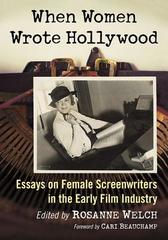
Months of research went into the creation of the essays in “When Women Wrote Hollywood.” Here are some of the resources used to enlighten today’s film lovers to the female pioneers who helped create it.
* A portion of each sale from Amazon.com directly supports our blogs
** Many of these books may be available from your local library. Check it out!
† Available from the LA Public Library
Highlighting the articles in the past editions of the Journal of Screenwriting, of which I am the Book Reviews Editor. Hopefully these abstracts will entice you to did a little deeper into the history and future of screenwriting. — Rosanne
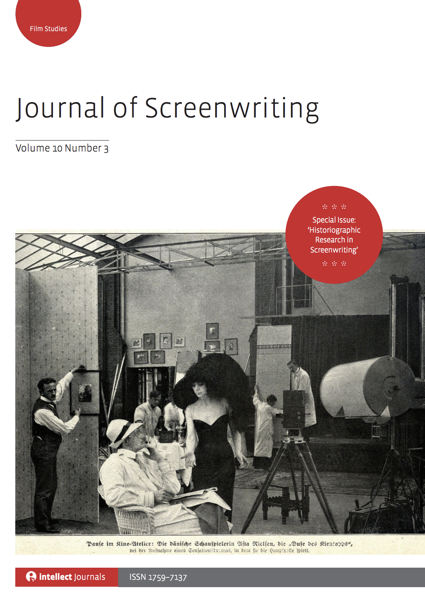
In 1912, with demand for story material increasing in a growing market, writing was becoming ever more essential to commercial film production in the United States. With several important legal developments that year, however, the marketplace for story material would begin to collapse as amateur screenwriters failed to gain the same legal protections as those producing finished films, rendering their creative material entirely susceptible to piracy from above. Despite several initiatives by advocates for non-professional writers and a few members of Congress, screenwriters would not receive legal protection for unpublished material until 1978. Throughout the Golden Age of Hollywood, then, but dating back to the origins of copyright protection for finished commercial films, US copyright law encouraged Hollywood to produce story material in a closed, intellectually isolated and commercially protected shop, more closely resembling an enigmatic ‘culture industry’ than a ‘people’s art form’. This article examines a convergence of state institutions, private enterprise and commercial trade press that helped to radically re-define the creative processes underwriting film production and the system of compensation for creative material that would delimit relations of production at the beginnings of the American film industry.
The Journal of Screenwriting is an international double-blind peer-reviewed journal that is published three times a year. The journal highlights current academic and professional thinking about the screenplay and intends to promote, stimulate and bring together current research and contemporary debates around the screenplay whilst encouraging groundbreaking research in an international arena. The journal is discursive, critical, rigorous and engages with issues in a dynamic and developing field, linking academic theory to screenwriting practice.
Months of research went into the creation of the essays in “When Women Wrote Hollywood.” Here are some of the resources used to enlighten today’s film lovers to the female pioneers who helped create it.
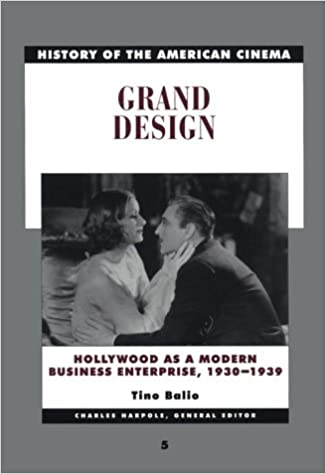
The advent of color, big musicals, the studio system, and the beginning of institutionalized censorship made the thirties the defining decade for Hollywood. The year 1939, celebrated as “Hollywood’s greatest year,” saw the release of such memorable films as Gone with the Wind, The Wizard of Oz, and Stagecoach. It was a time when the studios exercised nearly absolute control over their product as well as over such stars as Bette Davis, Clark Gable, and Humphrey Bogart. In this fifth volume of the award-winning series History of the American Cinema, Tino Balio examines every aspect of the filmmaking and film exhibition system as it matured during the Depression era.
* A portion of each sale from Amazon.com directly supports our blogs
** Many of these books may be available from your local library. Check it out!
† Available from the LA Public Library
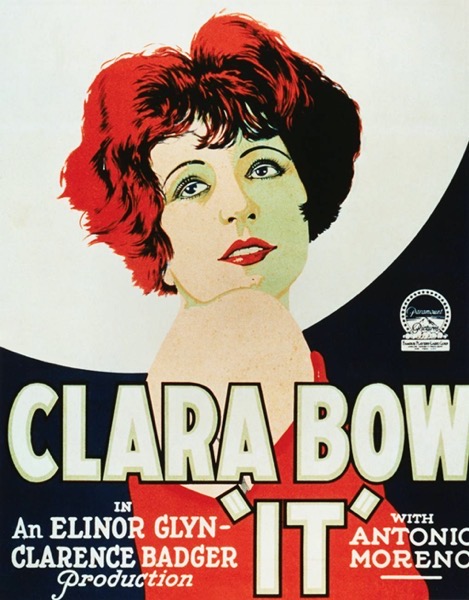
“It” is a 1927 American silent romantic comedy film that tells the story of a shop girl who sets her sights on the handsome, wealthy boss of the department store where she works. It is based on a novella by Elinor Glyn that was originally serialized in Cosmopolitan magazine.
This film turned actress Clara Bow into a major star, and led people to label her the It girl.
The film had its world premiere in Los Angeles on January 14, 1927, followed by a New York showing on February 5, 1927. “It” was released to the general public on February 19, 1927.
The picture was considered lost for many years, but a Nitrate-copy was found in Prague in the 1960s.[1] In 2001, “It” was selected for preservation in the United States National Film Registry by the Library of Congress as being “culturally, historically, or aesthetically significant”.[2][3] — Wikipedia
Elinor Glyn (née Sutherland; 17 October 1864 – 23 September 1943) was a British novelist and scriptwriter who specialised in romantic fiction, which was considered scandalous for its time, although her works are relatively tame by modern standards. She popularized the concept of the It-girl, and had tremendous influence on early 20th-century popular culture and, possibly, on the careers of notable Hollywood stars such as Rudolph Valentino, Gloria Swanson and, especially, Clara Bow. — Wikipedia
* A portion of each sale from Amazon.com directly supports our blogs ** Many of these books may be available from your local library. Check it out! † Available from the LA Public Library
* A portion of each sale from Amazon.com directly supports our blogs
** Many of these books may be available from your local library. Check it out!
† Available from the LA Public Library
Subscribe to Rosanne’s Channel and receive notice of each new video!
In honor of Halloween – and in service to my teaching philosophy —
“Words Matter. Writers Matter. Women Writers Matter.”
I presented this holiday lecture “When Women Write Horror” on Tuesday, October 29th, 2019. Researching the many, many women who have written horror stories – in novels, films and television – brought new names to my attention who I am excited to start reading. I hope you will be, too!
Transcript:
What’s interesting to me about The Exorcist — again, written by a guy, adapted by a guy — when we think Exorcist we think about Linda Blair and the girl who had the demon in her, but they didn’t sell the movie on that. They sold the movie on the man who saves her — the priest who comes to exorcise the demon. They sold it as a boy’s movie, but it’s a girl’s movie. Right? So I think that’s a problem.
Highlighting the articles in the past editions of the Journal of Screenwriting, of which I am the Book Reviews Editor. Hopefully these abstracts will entice you to did a little deeper into the history and future of screenwriting. — Rosanne
The systematic collection and preservation of film and TV scripts at a national level has never been implemented in the United Kingdom. While the British Film Institute National Library (BFI) has a respectable collection of around 25,000 scripts, this has been built up from donations over the 75 years of the BFI’s existence. The silent film period, to 1930, is particularly affected by this lack of national care; the BFI has less than 100 British scripts from this period. Researchers from the University of Leeds spent several months in 2007 and 2008 seeking and collating information from around the world, with grant-aid support from the British Academy. The intention was to find out if any British silent film scripts had found a home in both British and foreign institutional collections, or elsewhere. The results were in general as expected – no major new collections were unearthed – but in part surprising. As a result of this a database has been compiled. Why should we search for scripts? It is now being realized that screenplay and other documentation hold information about the provenance and development of the screen idea that a film cannot provide. For some, the script may be a useful substitute for a lost film, but more importantly understanding how the film was envisaged before principal photography can reveal much about the industrial assumptions associated with film production in general, and about that screen idea in particular.
The Journal of Screenwriting is an international double-blind peer-reviewed journal that is published three times a year. The journal highlights current academic and professional thinking about the screenplay and intends to promote, stimulate and bring together current research and contemporary debates around the screenplay whilst encouraging groundbreaking research in an international arena. The journal is discursive, critical, rigorous and engages with issues in a dynamic and developing field, linking academic theory to screenwriting practice.
I promised to clean my desk before a full semester of online learning began… and I did. See? There’s room for my cat Spotted Leaf (named after a character in the Erin Hunter series of books about cats who live in the woods – Warriors). Spot (as we call her for short) enjoys hearing me talk to students about everything from films to fiction. Maybe in one of her past 9 lives she was a humanities professor, too!
Months of research went into the creation of the essays in “When Women Wrote Hollywood.” Here are some of the resources used to enlighten today’s film lovers to the female pioneers who helped create it.
Women Screenwriters is a study of more than 300 female writers from 60 nations, from the first film scenarios produced in 1986 to the present day. Divided into six sections by continent, the entries give an overview of the history of women screenwriters in each country, as well as individual biographies of its most influential.
* A portion of each sale from Amazon.com directly supports our blogs
** Many of these books may be available from your local library. Check it out!
† Available from the LA Public Library
An on-going series highlighting the women screenwriters of early Hollywood.
When I was first asked to create a history course for a new MFA focused on the mission of bringing more female voices and female-centric stories to Hollywood, I knew we had to start at the very beginning, when women ran Hollywood. No other course I had ever taken or been asked to teach focused on these women, some of whom I had been reading about since the summers of my childhood in Cleveland, Ohio. Back then, I went to the library once a week to collect a stack of memoirs by women I had seen interviewed on The Merv Griffin Show, women like Anita Loos and Adela Rogers St. Johns. Their stories introduced me to moguls like Louis B. Mayer or Jack Warner, who make up most of the history courses I later found in academia. Knowing better, I found most of those courses, and their accompanying textbooks, glossed over these women with a paragraph if they mentioned them at all. I conceived a course that would begin with these women who began Hollywood and culminate in research by each graduate student into the life and career of one particular early female screenwriter. That is what you find here. A collection of herstories about how these women lived, loved and created the stories that gave their audiences reasons to live and love in their own lives. — Dr. Rosanne Welch, Editor. When Women Wrote Hollywood
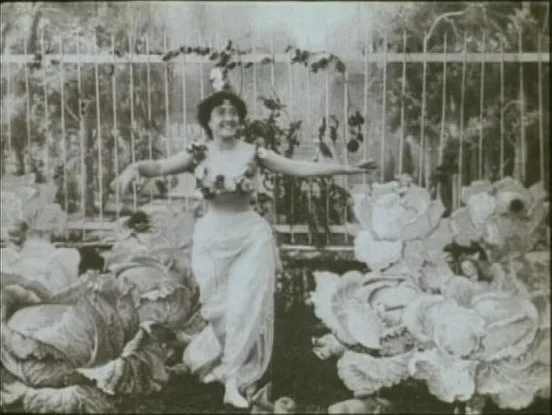
The 1896 version of La Fée aux Choux (The Fairy of the Cabbages) is a lost film that featured a honeymoon couple, a farmer, pictures of babies glued to cardboard, and one live baby. This is arguably the world’s first narrative film, and the first film directed by a woman.
Alice Guy-Blaché reported that she had to remake the film at least twice and this accounts for the two films dated 1900 and 1902 that are available to view online. Alice’s 1900 version employed one actress (the fairy), two live babies, and a number of dolls. Her 1902 version, later retitled Sage-femme de première classe, employed a honeymoon couple and a female baby merchant along with numerous babies and dolls. In a still photograph from the 1902 version called Sage-femme de première classe (Midwife First Class) Alice appears, dressed as a man. She does not play the husband in the film, but said that she “for fun pulled on the peasant clothes” for the photograph.
Alice’s 1896 film was the first to bring a story to an audience and the first to have a written scenario which Alice wrote.[1] The 1896 version was filmed on 60-millimeter film and was about 30 meters (about 90 feet) long. The 1900 version of La Fée aux Choux is on 35-millimeter film and is about sixty seconds long. The 1902 version is on 35-millimeter film and is about four minutes long.
All three versions refer to an old and popular French (and actually, European) fairy tale in which baby boys are born in cabbages, and baby girls are born in roses.
Alice Guy-Blaché, the director of La Fée aux Choux, is one of the early cinema’s most important figures, and had a long career as a director, producer and studio owner, working in both France and the United States. — Wikipedia
Alice Guy-Blaché (July 1, 1873 – March 24, 1968) was a pioneer filmmaker, active from the late 19th century, and one of the first to make a narrative fiction film.[2] From 1896 to 1906 she was probably the only female filmmaker in the world. [3] She experimented with Gaumont’s Chronophone sound syncing system, color tinting, interracial casting, and special effects. She was a founder and artistic director of the Solax Studios in Flushing, New York, in 1908. In 1912 Solax invested $100,000 for a new studio in Fort Lee, New Jersey, the center of American filmmaking prior to the establishment of Hollywood. That same year she made the film A Fool and his Money, with a cast comprised only African-American actors. The film is now at the National Center for Film and Video Preservation at the American Film Institute.[4] — Wikipedia
* A portion of each sale from Amazon.com directly supports our blogs ** Many of these books may be available from your local library. Check it out! † Available from the LA Public Library
* A portion of each sale from Amazon.com directly supports our blogs
** Many of these books may be available from your local library. Check it out!
† Available from the LA Public Library
Subscribe to Rosanne’s Channel and receive notice of each new video!
In honor of Halloween – and in service to my teaching philosophy —
“Words Matter. Writers Matter. Women Writers Matter.”
I presented this holiday lecture “When Women Write Horror” on Tuesday, October 29th, 2019. Researching the many, many women who have written horror stories – in novels, films and television – brought new names to my attention who I am excited to start reading. I hope you will be, too!
Transcript:
Another famous female in horror films is Jamie Lee Curtis. She also happens to be another Hollywood childhood because her parents are both actors right, but she starts an interesting trend because as a young person doing the first Halloween, which was based on the idea of babysitters being terrorized by a bad evil guy. She is actually — I forgot — as a child actor she could have been Linda Blair in The Exorcist, yeah. She was up for that part and their parents said “No that’s too horrifying. You shouldn’t do that. We don’t want you to go through that experience.” So it happened to Linda Blair whose career was over at the end of that movie. Nobody ever took her seriously after the spinning head and the puking. It was like too much right, whereas Jamie Lee Curtis didn’t do that job, grew up a little more, did Halloween and then has had a 40-year career. So it’s an interesting thought.


 †
†
![27 The Exorcist from When Women Write Horror with Dr. Rosanne Welch [Video] (25 seconds)](https://rosannewelch.com/wp-content/uploads/2020/09/rmw-cpp-horror-27.png)


![26 Jamie Lee Curtis from When Women Write Horror with Dr. Rosanne Welch [Video] (47 seconds)](https://rosannewelch.com/wp-content/uploads/2020/09/rmw-cpp-horror-26.png)