From The Journal Of Screenwriting V6 Issue 1: IEDs and a Jack-in-the-Box: The mystery of motivation in The Hurt Locker (2008) by Marshall Deutelbaum

Highlighting the articles in the past editions of the Journal of Screenwriting, of which I am the Book Reviews Editor. Hopefully these abstracts will entice you to did a little deeper into the history and future of screenwriting. — Rosanne


IEDs and a Jack-in-the-Box: The mystery of motivation in The Hurt Locker (2008) by Marshall Deutelbaum

Though based upon his non-fiction article ‘The Man in the Bomb Suit’, published in Playboy in 2005, the dramatic structure of Mark Boal’s script for The Hurt Locker (2008) is eccentric, only revealing its true subject, the motivation of its central character for being a bomb technician, just before its ending. In comparison with the clarity of motivations in Paul Haggis’ script for In the Valley of Elah (2007), adapted by him from an earlier non-fiction essay by Boal that also takes place during the Iraq war, the script for The Hurt Locker deviates decidedly from the format of classical Hollywood narrative; because he lacks a clearly defined goal, the psychology and motivations of the central character remain obscure. Indeed a comparison of the final script with an earlier version readily illustrates how rigorously insights into the character’s motivations, and his self-awareness, were reduced. As a result, The Hurt Locker in its final version asks considerably more imaginative and intellectual engagement from its viewers than most commercial cinema.

From The Journal Of Screenwriting V6 Issue 1: IEDs and a Jack-in-the-Box: The mystery of motivation in The Hurt Locker (2008) by Marshall Deutelbaum


Journal of Screenwriting Cover

The Journal of Screenwriting is an international double-blind peer-reviewed journal that is published three times a year. The journal highlights current academic and professional thinking about the screenplay and intends to promote, stimulate and bring together current research and contemporary debates around the screenplay whilst encouraging groundbreaking research in an international arena. The journal is discursive, critical, rigorous and engages with issues in a dynamic and developing field, linking academic theory to screenwriting practice. 

Get your copy and subscription to the Journal of Screenwriting Today!


* A portion of each sale from Amazon.com directly supports our blogs
** Many of these books may be available from your local library. Check it out!


09 Parker, Grandmothers, and Husbands from “Female Creatives & A Star Is Born” [Video]

09 Parker, Grandmothers, and Husbands from

Transcript:

Okay. Here’s where I find Dorothy Parker’s female focus coming to us. It begins with this grandmother. A female character has the money to give her granddaughter what she needs to follow her dream. That’s a big deal. Thinking that a woman in that period — who is now some 50 years older than the woman starring in the film — could have agency and could choose to give the money and trust her granddaughter when her own parents are not trusting her. I think that relationship is so key. That maternal relationship is a very big deal. Dorothy Parker’s mother died when she was quite young. I think she was 9 or 10. She didn’t like her stepmother but she liked her grandmother. So clearly that’s represented in this piece. Also even though Esther seems a little weak and fluffy at some points, she certainly stands up for herself when she needs to right? In this, we see Norman is a very desperate and envious guy. Some of what we read about Alan Campbell, he was desperate to succeed. He was desperate to be famous. After they divorced and he couldn’t get a job screenwriting, a producer literally said to him “Look, get back together with the old lady. She’s the one we want. Together we’ll hire you.” Imagine how humiliating that would be for someone and not man or woman but I want to be talented. I want to be recognized as someone of quality but I can’t be without attaching myself to this other person.

Watch this entire presentation

Connections at conferences matter! Through the most recent SCMS, I met Vicki Callahan, whose film history focus right now is on Mabel Normand. When she learned I could put together a lecture on the importance of the female voice in the A Star is Born franchise she asked me to give that lecture to her master students.

It made for a great opportunity for me to hone the ideas I’m working on for a chapter on that franchise that I’m writing for a new book from Bloomsbury: The Bloomsbury Handbook Of International Screenplay Theory. It’s always nice when one piece of research can be purposed in other ways – and it’s always fun revisiting such a female-centric film franchise – one that drew the talents of such powerful performers as Janet Gaynor, Judy Garland, Barbara Streisand, and Lady Gaga.

Find out why in this lecture!

RMW Rosanne Signature for Web


On Arthur Laurents and The Way We Were

Thewaywewere

Going to YouTube to find a fun clip to add to someone’s FB post generally leads down the rabbit hole (thank you Lewis Carroll for inventing Alice’s Adventures in Wonderland and therefore inventing the phrase “down the rabbit hole”). 

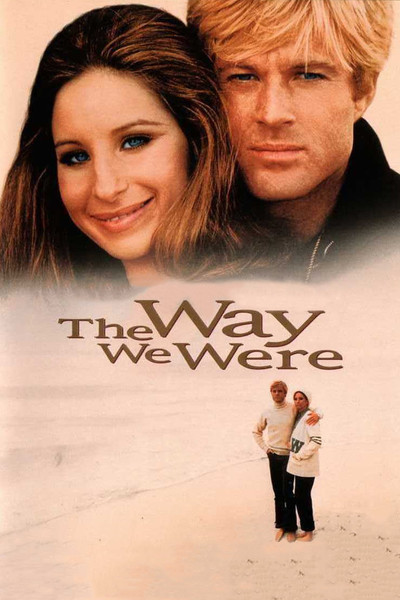
Last week it led me to clips from The Way We Were, written by Arthur Laurents and starring Barbra Streisand and Robert Redford.

I had re-read Laurents’ autobiography — Original Story — over the summer since I love reading about how writers came up with their best work (and his book had a whole chapter on it complete with explanations for a bad cut by the director and studio execs that destroyed a key reason the couple splits up – spoiler alert).

Iconic is overused but it fits here. That love story with an unexpected but completely organic ending is a classic for a reason – all the parts added up to the perfect whole.  I wanted to highlight this scene because of the power it gives the female character and the fear that power can have on the equally powerful male character.  I can’t think of too many scenes that can do that – enhanced by the power both of these superstars brought to their performances.

Resources

All About The Almighty Johnsons with the Fake Geek Girls Podcast – Episode 165 [Audio]

As we’ve all been advised, if you put something out on the internet folks will stumble over you and your work and offer you new opportunities.

That happened last month when Melissa Banks, who co-hosts the Fake Geek Girls podcast found an essay I had written and recorded to my blog in 2015 (How the Female Characters in The Almighty Johnsons were Misused – and how that likely lead to the early end of a great series…). 

All About The Almighty Johnsons with the Fake Geek Girls Podcast - Episode 165

It’s about a New Zealand show called The Almighty Johnsons and my opinion had to do with how I felt the writers had done a disservice to the female characters on the show. So here in 2021 Melissa and her co-host were planning an episode around the show, found my essay and asked for permission to quote it, which I happily gave.

If you know the Almighty Johnsons this whole episode will be of interest; if not my quote comes into the conversation here at 1:18:25  when they Introduce to the section on gender in the show and then at 1:19:22 – when they begin using my quotes.

Listen to All About The Almighty Johnsons with the Fake Geek Girls Podcast – Episode 165

08 A Star Is Born (1937) from “Female Creatives & A Star Is Born” [Video]

08 A Star Is Born (1937) from

Transcript:

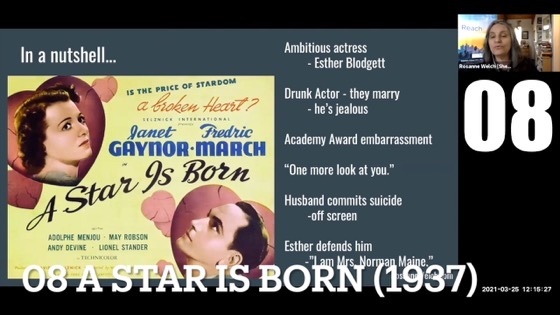
In a nutshell, what do we see in the first version of A Star Is Born?” We have this ambitious actress. We have a drunken actor, not a director. They do marry and he is jealous of her despite how bad that makes him feel. We have this classic scene where she wins an Academy Award and he shows up drunk and destroys and humiliates the evening right? We have this classic line “Can I have one more look at you”, right before I kill myself but you don’t know that’s what I’m about to do right? We have the husband committing suicide off-screen. We’re going to see him walk off into the ocean. We’re not going to see him dead on our screen and of course, we’re going to have this ending where she defends him to the society that destroyed him — to Hollywood — by saying “I am Mrs. Norman Maine” and there’s a lot — we’ll talk about this a little if we have some time — there’s some argument. My undergrad students nowadays will say they hate that line and they’re seeing it as her stepping back and losing her identity and I don’t think that’s how it was intended. I think if we think again about the time period, this was her asserting this man meant something and you people ruined him and I will not forget him right? So it’s an interesting line to see. Everything changes as we move through society and we bring our own baggage to what we watch. So we have to think about that. It was intended to be a monument to him and not a detriment to her at this point.

Watch this entire presentation

Connections at conferences matter! Through the most recent SCMS, I met Vicki Callahan, whose film history focus right now is on Mabel Normand. When she learned I could put together a lecture on the importance of the female voice in the A Star is Born franchise she asked me to give that lecture to her master students.

It made for a great opportunity for me to hone the ideas I’m working on for a chapter on that franchise that I’m writing for a new book from Bloomsbury: The Bloomsbury Handbook Of International Screenplay Theory. It’s always nice when one piece of research can be purposed in other ways – and it’s always fun revisiting such a female-centric film franchise – one that drew the talents of such powerful performers as Janet Gaynor, Judy Garland, Barbara Streisand, and Lady Gaga.

Find out why in this lecture!

RMW Rosanne Signature for Web


June Mathis: An Eye for Talent — Dr. Rosanne Welch, Script magazine, October 2021

June Mathis: An Eye for Talent -- Dr. Rosanne Welch, Script magazine, October 2021

Though she wrote over 100 films in the Silent Era and was a founding member of the Academy of Motion Picture Arts and Sciences, June Mathis appears in film history books (when she does) as a writer-producer with an eye for talent in that she gave both Buster Keaton and Rudolph Valentino their debuts on film.

She came to film from an early career as a child in vaudeville, despite suffering from undiagnosed heart issues. Born as June Hughes in 1887 in Leadville, Colorado there was no father listed and the child would later take Mathis, the last name of her stepfather, as her own.

Read June Mathis: An Eye for Talent — Dr. Rosanne Welch, Script magazine, October 2021


Read about more women from early Hollywood


From The Journal Of Screenwriting V6 Issue 1: The writer as director: A case study – Brothers and Sisters (1981) by Richard Woolley

Highlighting the articles in the past editions of the Journal of Screenwriting, of which I am the Book Reviews Editor. Hopefully these abstracts will entice you to did a little deeper into the history and future of screenwriting. — Rosanne


The writer as director: A case study – Brothers and Sisters (1981) by Richard Woolley

This is a practitioner’s case history of a particular, personal scripting process, in the context of Arts public funding of film in the United Kingdom, before the rise of the current screenwriting orthodoxy. The role of the script for an auteur writer-director is, here, seen more clearly as a personal tool for the development of the screen idea; format, for example, works creatively for the director rather than as a standardized part of the conventional memorandum for others it has become. Using the experience of scripting Brothers and Sisters (1981) I reflect on the interconnection between script and eventual film as a whole process, rather than as a separate set of skills, and conclude that the best way of achieving those representational goals in the screenplay context should remain open to continual experiment and debate by researchers and practitioners alike, and not be closed off for all time by absolutist formulas and set-in-stone formats.

From The Journal Of Screenwriting V6 Issue 1: The writer as director: A case study – Brothers and Sisters (1981) by Richard Woolley


Journal of Screenwriting Cover

The Journal of Screenwriting is an international double-blind peer-reviewed journal that is published three times a year. The journal highlights current academic and professional thinking about the screenplay and intends to promote, stimulate and bring together current research and contemporary debates around the screenplay whilst encouraging groundbreaking research in an international arena. The journal is discursive, critical, rigorous and engages with issues in a dynamic and developing field, linking academic theory to screenwriting practice. 

Get your copy and subscription to the Journal of Screenwriting Today!


* A portion of each sale from Amazon.com directly supports our blogs
** Many of these books may be available from your local library. Check it out!
The Difficulties and Delicacies of Writing the First Female Doctor in 50+ years (Complete) [Video]

It was great to be able to attend this year’s SD WhoCon in San Diego and present this lecture on “The Difficulties and Delicacies of Writing the First Female Doctor in 50+ years” in which I discuss how successful I think showrunner Christopher Chibnall was in making that transition.

It gave me a chance to talk about the creative work of a showrunner/screenwriter while also reconnecting to some friends we had met at this same convention some 3 years ago – and to talk about one of my favorite subjects – Doctor Who!

The Difficulties and Delicacies of Writing the First Female Doctor in 50+ years (Complete) [Video]


07 More On Dorothy Parker from “Female Creatives & A Star Is Born” [Video]

07 More On Dorothy Parker from

Transcript:

Also has been said about her, her stories feature female characters trying to square exhilarating new choices with the enduring bold constraints of social expectation. The social expectation in A Star Is Born is that a man should be more successful than his wife. That is something that happened in any particular level of the society at the time. Also, her heroines are lovelorn and there are always suicidal alcoholics in so many of her pieces and this appears in other films she wrote without Alan. They did effect eventually split up and get divorced. So she wrote for Hitchcock. He specifically sought her out. He wanted a writer as famous as she and she got an Oscar nomination both for A Star Is Born and for Smash-Up, the story of a woman which was about a female alcoholic. So clearly these are all pieces of her little ingredient book that she threw together into A Star Is Born.

Watch this entire presentation

Connections at conferences matter! Through the most recent SCMS, I met Vicki Callahan, whose film history focus right now is on Mabel Normand. When she learned I could put together a lecture on the importance of the female voice in the A Star is Born franchise she asked me to give that lecture to her master students.

It made for a great opportunity for me to hone the ideas I’m working on for a chapter on that franchise that I’m writing for a new book from Bloomsbury: The Bloomsbury Handbook Of International Screenplay Theory. It’s always nice when one piece of research can be purposed in other ways – and it’s always fun revisiting such a female-centric film franchise – one that drew the talents of such powerful performers as Janet Gaynor, Judy Garland, Barbara Streisand, and Lady Gaga.

Find out why in this lecture!

RMW Rosanne Signature for Web


From The Journal Of Screenwriting V6 Issue 1: Scriptwriting as paradox and process: The complex case of Eric Rohmer by Fiona Handyside

Highlighting the articles in the past editions of the Journal of Screenwriting, of which I am the Book Reviews Editor. Hopefully these abstracts will entice you to did a little deeper into the history and future of screenwriting. — Rosanne


Scriptwriting as paradox and process: The complex case of Eric Rohmer by Fiona Handyside
 
This article discusses the creative working processes of Eric Rohmer (1920–2010). It argues that his method, of working on film subjects for decades, and carefully preparing every aspect of his films, contrasts with a deliberately ‘amateur’ and improvisational approach, influenced to a certain extent by ethnographic film. Rohmer provides an unusual and fascinating case study, combining approaches to scriptwriting that are usually seen as diametrically opposed.

From The Journal Of Screenwriting V6 Issue 1: Scriptwriting as paradox and process: The complex case of Eric Rohmer by Fiona Handyside


Journal of Screenwriting Cover

The Journal of Screenwriting is an international double-blind peer-reviewed journal that is published three times a year. The journal highlights current academic and professional thinking about the screenplay and intends to promote, stimulate and bring together current research and contemporary debates around the screenplay whilst encouraging groundbreaking research in an international arena. The journal is discursive, critical, rigorous and engages with issues in a dynamic and developing field, linking academic theory to screenwriting practice. 

Get your copy and subscription to the Journal of Screenwriting Today!


* A portion of each sale from Amazon.com directly supports our blogs
** Many of these books may be available from your local library. Check it out!