Now Available: The Civil War on Film (Hollywood History) by Dr. Rosanne Welch and Dr. Peg Lamphier

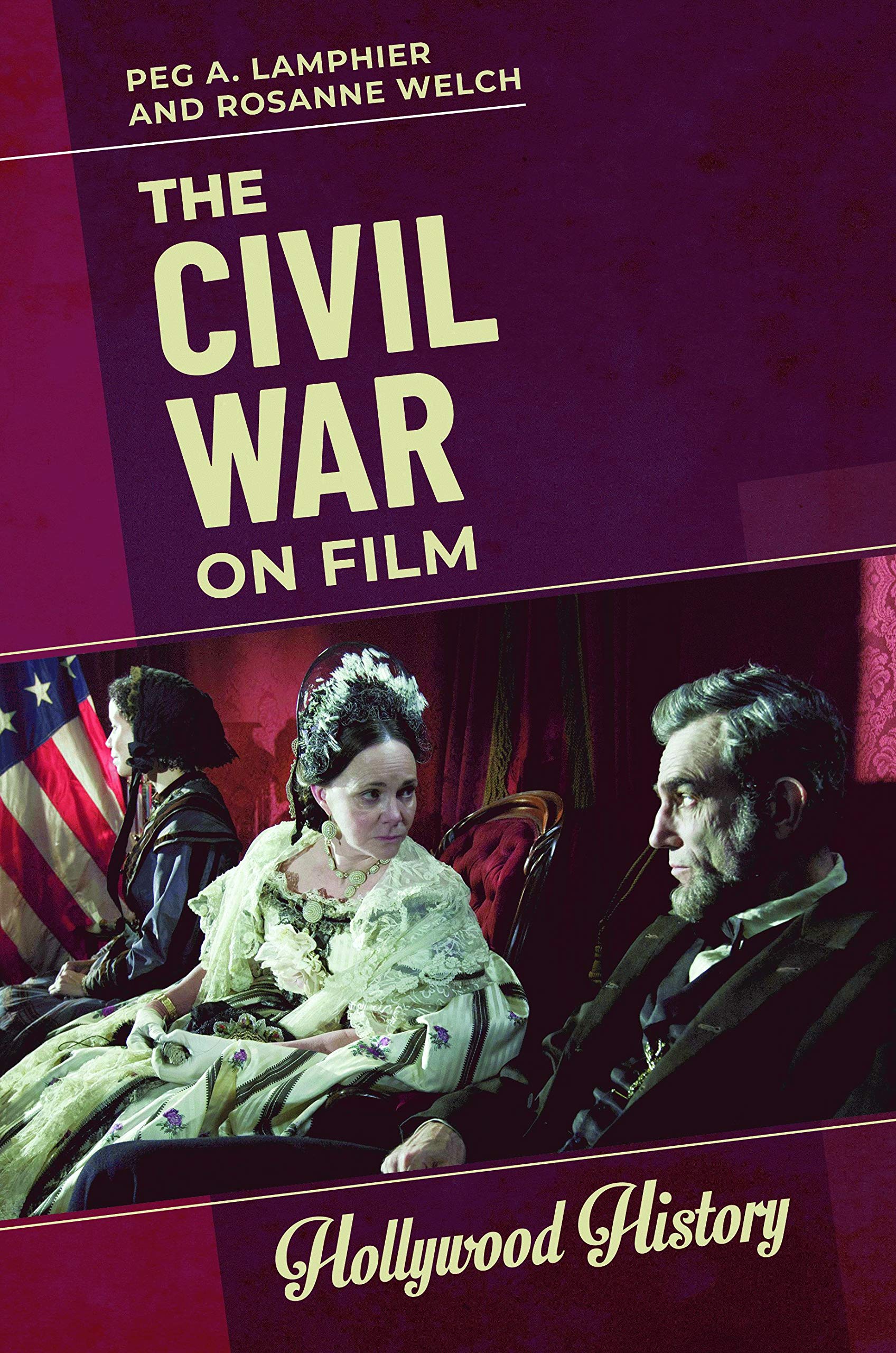
My newest book The Civil War on Film (co-written with my colleague Peg Lamphier as part of ABC-Clio’s Hollywood History series) was published today. 

Peg and I discuss 10 Civil War films based on their accuracy and cultural context. It is no surprise that we agree with a collection of historians that the most accurate of all the films of the Civil War is Glory (written by Kevin Jarre), though even that film makes the ‘mistake’ of omitting the fact that Harriet Tubman served as a spy for the 54th Massachusetts Infantry Regiment. 

As we say about many of the films, one film can’t encapsulate the entirety of a historical event (though Free State of Jones (written by Gary Ross) does try, and here we admit that that attempt to do it all makes for a long and plodding film, which is sad since it is a thorough portrait of Reconstruction, which is nearly never covered in films as they all prefer ending when the war ends).

As always it was a pleasure to work with Peg.  We’re in the middle of our second book for this series – chronicling how Women’s History is covered in films coming sometime in 2021.

Want to use The Civil War On Film as a classroom text?
Contact ABC-CLIO for more information

The Civil War on Film will inform high school and college readers interested in Civil War film history on issues that arise when film viewers confuse entertainment with historical accuracy.

The nation’s years of civil war were painful, destructive, and unpleasant. Yet war films tend to embrace mythologies that erase that historical reality, romanticizing the Civil War. The editors of this volume have little patience for any argument that implies race-based slavery isn’t an entirely repugnant economic, political, and cultural institution and that the people who fought to preserve slavery were fighting for a glorious and admirable cause

To that end, The Civil War on Film will open with a timeline and introduction and then explore ten films across decades of cinema history in ten chapters, from Birth of a Nation, which debuted in 1915, to The Free State of Jones, which debuted one hundred and one years later. It will also analyze and critique the myriad of mythologies and ideologies which appear in American Civil War films, including Lost Cause ideation, Black Confederate fictions, Northern Aggression mythologies, and White Savior tropes. It will also suggest the way particular films mirror the time in which they were written and filmed. Further resources will close the volume.

  • Makes clear that depictions of the Civil War on film are often mythologized
  • Analyzes films in a manner that shows students the historical context in which the films were made and viewed
  • Goes beyond just synopses and historical facts, helping students to develop critical thinking skills
  • Stimulates debate over the various ways the war was interpreted and experienced

Film discussed include:

  1. Gone with the Wind (1939)
  2. Friendly Persuasion (1957)
  3. The Good, the Bad and the Ugly (1966)
  4. Glory (1989)
  5. Gettysburg (1993)
  6. Andersonville (1996)
  7. Ride with the Devil (1999)
  8. Gangs of New York (2002)
  9. Lincoln (2012)
  10. Free State of Jones (2016)


* A portion of each sale from Amazon.com directly supports our blogs
** Many of these books may be available from your local library. Check it out!

More books from Dr. Rosanne Welch


30 The “Final Girl” Trope from When Women Write Horror with Dr. Rosanne Welch [Video] (43 seconds)

Watch this entire presentation

30 The

Subscribe to Rosanne’s Channel and receive notice of each new video!


Transcript:

Now one of the things we have to think about — side note — when we think about horror movies again — is what they’re telling us. In this movie, as we know, spoiler alert, he’s the bad guy. Anthony Perkins was gay and by casting him they knew the audience would feel awkward about him. there would be something wrong with him They didn’t have to say what it was. They just knew society would find him wrong and so they cast him as the bad guy right? And so under all of this, what we’re saying is you can’t trust gay men. They’re dangerous. Don’t be near them. That’s the underlying concept behind Psycho. So I think that’s really — I have to think about what are the messages we’re getting from the stuff we’re watching and the stuff we’re reading and how do we counter those if they’re messages that we don’t want to have but it’s a good movie. It’s a good movie but have to think about that.

A Note About This Presentation

A clip from my keynote speech at the 10th Screenwriters´(hi)Stories Seminar for the interdisciplinary Graduation Program in “Education, Art, and History of Culture”, in Mackenzie Presbyterian University, at São Paulo, SP, Brazil, focused on the topic “Why Researching Screenwriters (has Always) Mattered.” I was especially pleased with the passion these young scholars have toward screenwriting and it’s importance in transmitting culture across the man-made borders of our world.

To understand the world we have to understand its stories and to understand the world’s stories we must understand the world’s storytellers. A century ago and longer those people would have been the novelists of any particular country but since the invention of film, the storytellers who reach the most people with their ideas and their lessons have been the screenwriters. My teaching philosophy is that: Words matter, Writers matter, and Women writers matte, r so women writers are my focus because they have been the far less researched and yet they are over half the population. We cannot tell the stories of the people until we know what stories the mothers have passed down to their children. Those are the stories that last. Now is the time to research screenwriters of all cultures and the stories they tell because people are finally recognizing the work of writers and appreciating how their favorite stories took shape on the page long before they were cast, or filmed, or edited. But also because streaming services make the stories of many cultures now available to a much wider world than ever before.

Many thanks to Glaucia Davino for the invitation.


* A portion of each sale from Amazon.com directly supports our blogs
** Many of these books may be available from your local library. Check it out!
† Available from the LA Public Library

From The Journal Of Screenwriting V2 Issue 2: Escape from the stage? From play to screenplay in British cinema’s early sound period by Victoria Lowe

Highlighting the articles in the past editions of the Journal of Screenwriting, of which I am the Book Reviews Editor. Hopefully these abstracts will entice you to did a little deeper into the history and future of screenwriting. — Rosanne


Escape from the stage? From play to screenplay in British cinema’s early sound period by Victoria Lowe

In this article I discuss the evolution of the screenplay from play to film of Escape (1930) through a detailed examination of the archive correspondence between its producer Basil Dean and the original writer of the play, John Galsworthy. My aim is to provide a more nuanced account of the relationship between stage and screen practices at this time, one that goes beyond histories that have understood the adaptation of stage material to have been a burden from which British cinema had to escape, in order to create its own distinctive identity. I argue that the relationship between the two practices was affected by the coming of sound, and the cultural anxiety and debates around the film industry and national identity formations that it engendered. I then examine Basil Dean’s thoughts about the adapted screenplay, in particular his ideas around the retention of the original author’s dialogue, and his practical response to the issues in terms of his collaboration with Galsworthy in the writing of the screenplay of Escape, one of the first talkies made in the United Kingdom.


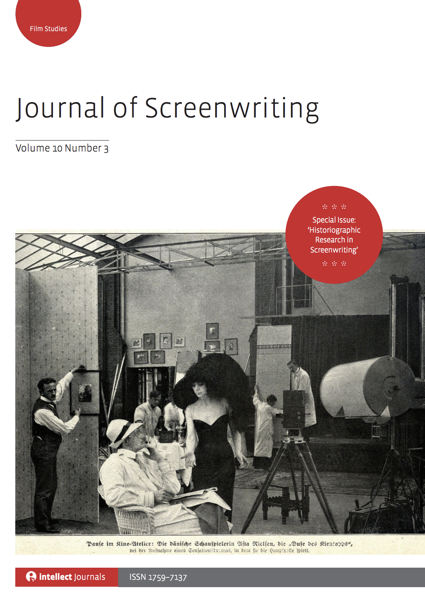
The Journal of Screenwriting is an international double-blind peer-reviewed journal that is published three times a year. The journal highlights current academic and professional thinking about the screenplay and intends to promote, stimulate and bring together current research and contemporary debates around the screenplay whilst encouraging groundbreaking research in an international arena. The journal is discursive, critical, rigorous and engages with issues in a dynamic and developing field, linking academic theory to screenwriting practice. 

Get your copy and subscription to the Journal of Screenwriting Today!


* A portion of each sale from Amazon.com directly supports our blogs
** Many of these books may be available from your local library. Check it out!

29 Screenwriters Are Important from Why Researching Screenwriters (has Always) Mattered [Video] (52 seconds)

Watch this entire presentation

29 Screenwriters Are Important from Why Researching Screenwriters (has Always) Mattered

Subscribe to Rosanne’s Channel and receive notice of each new video!


Transcript:

But we always knew that writers were important — if not the most important — because, if the directors were so important — when we had the Blacklist, 9 out of 10 of those people were writers. It wasn’t the director’s philosophy that we were afraid of showing the world. It was the writer’s philosophy. It was their ideas about poverty and what it was like in America and how we needed to fix it. That’s what scared the big guys and that’s why they all went to prison, right? They aren’t directors. They’re writers. Yeah, they all went to prison for about 10 months because they wouldn’t give names of fellow communists and it didn’t even matter that nobody cared. Half of them weren’t — some were communists and it’s legal for them to be a communist in the United States, but they were mostly all writers. So we know that writers are deeply important because it’s the stories that matter because those were the things that changed people, right? That’s what fascinates me.

A Note About This Presentation

A clip from my keynote speech at the 10th Screenwriters´(hi)Stories Seminar for the interdisciplinary Graduation Program in “Education, Art, and History of Culture”, in Mackenzie Presbyterian University, at São Paulo, SP, Brazil, focused on the topic “Why Researching Screenwriters (has Always) Mattered.” I was especially pleased with the passion these young scholars have toward screenwriting and it’s importance in transmitting culture across the man-made borders of our world.

To understand the world we have to understand its stories and to understand the world’s stories we must understand the world’s storytellers. A century ago and longer those people would have been the novelists of any particular country but since the invention of film, the storytellers who reach the most people with their ideas and their lessons have been the screenwriters. My teaching philosophy is that: Words matter, Writers matter, and Women writers matte, r so women writers are my focus because they have been the far less researched and yet they are over half the population. We cannot tell the stories of the people until we know what stories the mothers have passed down to their children. Those are the stories that last. Now is the time to research screenwriters of all cultures and the stories they tell because people are finally recognizing the work of writers and appreciating how their favorite stories took shape on the page long before they were cast, or filmed, or edited. But also because streaming services make the stories of many cultures now available to a much wider world than ever before.

Many thanks to Glaucia Davino for the invitation.


* A portion of each sale from Amazon.com directly supports our blogs
** Many of these books may be available from your local library. Check it out!
† Available from the LA Public Library

From The “When Women Wrote Hollywood Archives 43: COMEDY OUTLOOK SADDENS SPEWACK (1960) – The New York Times

Months of research went into the creation of the essays in “When Women Wrote Hollywood.” Here are some of the resources used to enlighten today’s film lovers to the female pioneers who helped create it.

From The

COMEDY OUTLOOK SADDENS SPEWACK; Calls Times ‘Unfortunate’ for the Writer of Humor — Cites ‘Method’ School as ‘Grim’
By Louis Calta

Available in facsimile version on the NY Times web site.


Buy “When Women Wrote Hollywood” Today!


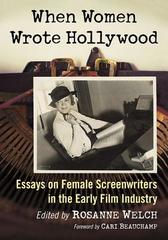
When Women Wrote Hollywood: Essays on Female Screenwriters in the Early Film Industry

Paperback Edition | Kindle Edition | Google Play Edition

Help Support Local Bookstores — Buy at Bookshop.org

* A portion of each sale from Amazon.com directly supports our blogs
** Many of these books may be available from your local library. Check it out!
† Available from the LA Public Library

When Women Wrote Hollywood: The Movies – 9 in a series – Suspense (1913) Wr: Lois Weber

When Women Wrote Hollywood: The Movies - 9 in a series - Suspense (1913) Wr: Lois Weber

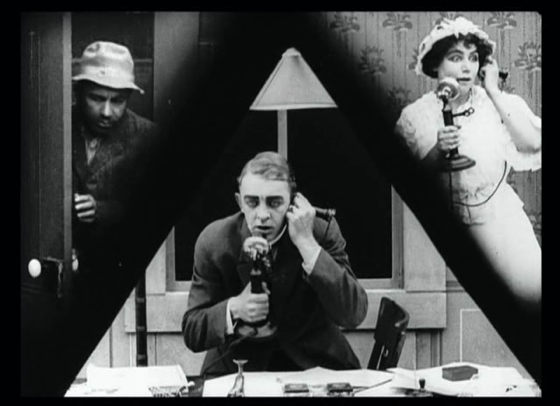
Suspense 1913 film shot

Suspense is a 1913 American silent short film thriller directed by Lois Weber and Phillips Smalley. Weber also wrote the scenario and stars in the film with Valentine Paul. The film features early examples of a split screen shot[1] and a car chase. The Internet Movie Database lists Lon Chaney as having an unconfirmed and uncredited brief role;[2] however, this is disputed by silentera.com, which states “Despite attributions to the contrary, Lon Chaney does not appear in the film.”[3][4][5]

A print of the film is preserved at the film archive of the British Film Institute.[6]

A servant leaves a new mother with only a written letter of notice, placing her key under the doormat as she leaves. Her exit attracts the attention of a tramp to the house. As the husband has previously phoned that he is working late, the wife decides not to ring back when she finds the note but does ring back when she sees the tramp. Her husband listens, horrified, as she documents the break-in and then the tramp cuts the line. The husband steals a car and is immediately pursued by the car’s owner and the police, who nearly but don’t quite manage to jump into the stolen car during a high-speed chase. The husband manages to gain a lead over the police but then accidentally strikes a man smoking in the road and checks to see that he is okay. Meanwhile, the tramp is breaking into the room where the wife has locked herself and her baby, violently thrusting himself through the wood door, carrying a large knife. At that moment the husband arrives, pursued by the police. As the husband runs towards the home, the police fire warning shots into the air, panicking the hobo. He runs down the stairs, to be met by the husband at the front door. After a short struggle, he overpowers the hobo, who is then grabbed by the police. The husband runs upstairs, everything is explained, and all is forgiven as the couple embrace. — Wikipedia

More about Alice Guy Blaché

* A portion of each sale from Amazon.com directly supports our blogs
** Many of these books may be available from your local library. Check it out!
† Available from the LA Public Library


Buy “When Women Wrote Hollywood” Today!


When Women Wrote Hollywood: Essays on Female Screenwriters in the Early Film Industry

Paperback Edition | Kindle Edition | Google Play Edition

Help Support Local Bookstores — Buy at Bookshop.org

* A portion of each sale from Amazon.com directly supports our blogs
** Many of these books may be available from your local library. Check it out!
† Available from the LA Public Library

29 Unspoken Messages in Film from When Women Write Horror with Dr. Rosanne Welch [Video] (53 seconds)

Watch this entire presentation

29 Unspoken Messages in Film from When Women Write Horror with Dr. Rosanne Welch

Subscribe to Rosanne’s Channel and receive notice of each new video!


Transcript:

Now one of the things we have to think about — side note — when we think about horror movies again — is what they’re telling us. In this movie, as we know, spoiler alert, he’s the bad guy. Anthony Perkins was gay and by casting him they knew the audience would feel awkward about him. there would be something wrong with him They didn’t have to say what it was. They just knew society would find him wrong and so they cast him as the bad guy right? And so under all of this, what we’re saying is you can’t trust gay men. They’re dangerous. Don’t be near them. That’s the underlying concept behind Psycho. So I think that’s really — I have to think about what are the messages we’re getting from the stuff we’re watching and the stuff we’re reading and how do we counter those if they’re messages that we don’t want to have but it’s a good movie. It’s a good movie but have to think about that.

A Note About This Presentation

A clip from my keynote speech at the 10th Screenwriters´(hi)Stories Seminar for the interdisciplinary Graduation Program in “Education, Art, and History of Culture”, in Mackenzie Presbyterian University, at São Paulo, SP, Brazil, focused on the topic “Why Researching Screenwriters (has Always) Mattered.” I was especially pleased with the passion these young scholars have toward screenwriting and it’s importance in transmitting culture across the man-made borders of our world.

To understand the world we have to understand its stories and to understand the world’s stories we must understand the world’s storytellers. A century ago and longer those people would have been the novelists of any particular country but since the invention of film, the storytellers who reach the most people with their ideas and their lessons have been the screenwriters. My teaching philosophy is that: Words matter, Writers matter, and Women writers matte, r so women writers are my focus because they have been the far less researched and yet they are over half the population. We cannot tell the stories of the people until we know what stories the mothers have passed down to their children. Those are the stories that last. Now is the time to research screenwriters of all cultures and the stories they tell because people are finally recognizing the work of writers and appreciating how their favorite stories took shape on the page long before they were cast, or filmed, or edited. But also because streaming services make the stories of many cultures now available to a much wider world than ever before.

Many thanks to Glaucia Davino for the invitation.


* A portion of each sale from Amazon.com directly supports our blogs
** Many of these books may be available from your local library. Check it out!
† Available from the LA Public Library

From The Journal Of Screenwriting V2 Issue 2: The first screenplays? American Mutoscope and Biograph scenarios revisited by Steven Price

Highlighting the articles in the past editions of the Journal of Screenwriting, of which I am the Book Reviews Editor. Hopefully these abstracts will entice you to did a little deeper into the history and future of screenwriting. — Rosanne


The first screenplays? American Mutoscope and Biograph scenarios revisited by Steven Price

This article builds on the earlier work of Patrick Loughney in discussing a series of texts written by Frank J. Marion and Wallace McCutcheon, and registered by American Mutoscope & Biograph (AM&B) at the Library of Congress in 1904–05. It assesses the arguments for regarding these as the earliest surviving texts that were written specifically in order to be filmed. Significant historical contexts include copyright disputes between the studios, developments in narrative film since 1902, and the problematic classification system at the Library of Congress that prompted AM&B to register a sequence of films as both ‘photographs’ and ‘dramatic compositions’. A comparison of the scenarios to the films provides evidence that they were written prior to filming. The formal arrangement of the scenarios is almost indistinguishable from that for contemporary playscripts, which may have been due to a deliberate attempt to facilitate their registration as ‘dramatic compositions’.


The Journal of Screenwriting is an international double-blind peer-reviewed journal that is published three times a year. The journal highlights current academic and professional thinking about the screenplay and intends to promote, stimulate and bring together current research and contemporary debates around the screenplay whilst encouraging groundbreaking research in an international arena. The journal is discursive, critical, rigorous and engages with issues in a dynamic and developing field, linking academic theory to screenwriting practice. 

Get your copy and subscription to the Journal of Screenwriting Today!


* A portion of each sale from Amazon.com directly supports our blogs
** Many of these books may be available from your local library. Check it out!

From The “When Women Wrote Hollywood Archives 42: Interpretations, a book of first poems (1912) by Zoë Akins

Months of research went into the creation of the essays in “When Women Wrote Hollywood.” Here are some of the resources used to enlighten today’s film lovers to the female pioneers who helped create it.

From The


Buy “When Women Wrote Hollywood” Today!


When Women Wrote Hollywood: Essays on Female Screenwriters in the Early Film Industry

Paperback Edition | Kindle Edition | Google Play Edition

Help Support Local Bookstores — Buy at Bookshop.org

* A portion of each sale from Amazon.com directly supports our blogs
** Many of these books may be available from your local library. Check it out!
† Available from the LA Public Library

From The Journal Of Screenwriting V2 Issue 2: An uneven marketplace of ideas: Amateur screenwriting, the Library of Congress and the struggle for copyright by Torey Liepa

Highlighting the articles in the past editions of the Journal of Screenwriting, of which I am the Book Reviews Editor. Hopefully these abstracts will entice you to did a little deeper into the history and future of screenwriting. — Rosanne


An uneven marketplace of ideas: Amateur screenwriting, the Library of Congress and the struggle for copyright by Torey Liepa

In 1912, with demand for story material increasing in a growing market, writing was becoming ever more essential to commercial film production in the United States. With several important legal developments that year, however, the marketplace for story material would begin to collapse as amateur screenwriters failed to gain the same legal protections as those producing finished films, rendering their creative material entirely susceptible to piracy from above. Despite several initiatives by advocates for non-professional writers and a few members of Congress, screenwriters would not receive legal protection for unpublished material until 1978. Throughout the Golden Age of Hollywood, then, but dating back to the origins of copyright protection for finished commercial films, US copyright law encouraged Hollywood to produce story material in a closed, intellectually isolated and commercially protected shop, more closely resembling an enigmatic ‘culture industry’ than a ‘people’s art form’. This article examines a convergence of state institutions, private enterprise and commercial trade press that helped to radically re-define the creative processes underwriting film production and the system of compensation for creative material that would delimit relations of production at the beginnings of the American film industry.


The Journal of Screenwriting is an international double-blind peer-reviewed journal that is published three times a year. The journal highlights current academic and professional thinking about the screenplay and intends to promote, stimulate and bring together current research and contemporary debates around the screenplay whilst encouraging groundbreaking research in an international arena. The journal is discursive, critical, rigorous and engages with issues in a dynamic and developing field, linking academic theory to screenwriting practice. 

Get your copy and subscription to the Journal of Screenwriting Today!


* A portion of each sale from Amazon.com directly supports our blogs
** Many of these books may be available from your local library. Check it out!