Connections at conferences matter! Through the most recent SCMS, I met Vicki Callahan, whose film history focus right now is on Mabel Normand. When she learned I could put together a lecture on the importance of the female voice in the A Star is Born franchise she asked me to give that lecture to her master students.
It made for a great opportunity for me to hone the ideas I’m working on for a chapter on that franchise that I’m writing for a new book from Bloomsbury: The Bloomsbury Handbook Of International Screenplay Theory. It’s always nice when one piece of research can be purposed in other ways – and it’s always fun revisiting such a female-centric film franchise – one that drew the talents of such powerful performers as Janet Gaynor, Judy Garland, Barbara Streisand, and Lady Gaga.
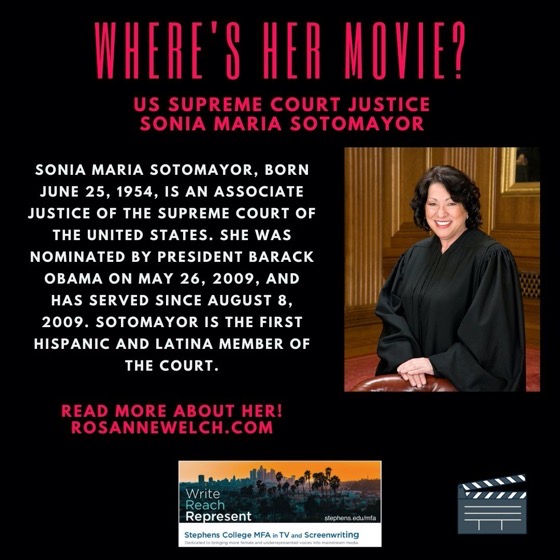
“Where’s HER Movie” posts will highlight interesting and accomplished women from a variety of professional backgrounds who deserve to have movies written about them as much as all the male scientists, authors, performers, and geniuses have had written about them across the over 100 years of film. This is our attempt to help write these women back into mainstream history. — Rosanne
One of the benefits of attending conferences is that you can meet the editors from the companies that have published some of your books face to face. That happened at the recent SCMS conference where I met Intellect editor James Campbell and he invited me to be a guest on his InstagramLive show.
We even had time to nerd out on our own favorite classic films across the eras which brought up fun memories of Angels with Dirty Faces, Back to the Future, Bonnie and Clyde, and of course, all things Star Wars from the original 3 to The Mandalorian. It’s always so fun to talk to fellow cinephiles.
Speaking with Dr. Rosanne Welch, Author, teacher, and television screenwriter. Today we cover everything from women in screenwriting to our favorite Jimmy Cagney movies and Friends.
In the latest installment of Monkees 101 – a segment of the Zilch: A Monkees Podcast which I co-host with Dr. Sarah Clark. We’re covering all 58 episodes of the show one at a time.
In the story Mike writes a new song, but the publishing company he tries to sell it to tries to rip him off and his musician pals come to his rescue. Lots of fun meta-moments for all the cast.
The Zilch Staff drops Tour News AND the “Dolenz Sings Nesmith” track lists before a double-header episode! First up Sarah talks to Nashville musician Walter Cherry about his ambitious 5(!) album Monkees cover project, and then it’s time for Monkees 101! Sarah and Rosanne talk I’ve Got a Little Song here, which aired November 28, 1966. Mike writes a new song, but the publishing company he tries to sell it to tries to rip him off.
Subscribe to Rosanne’s Channel and receive notice of each new video!
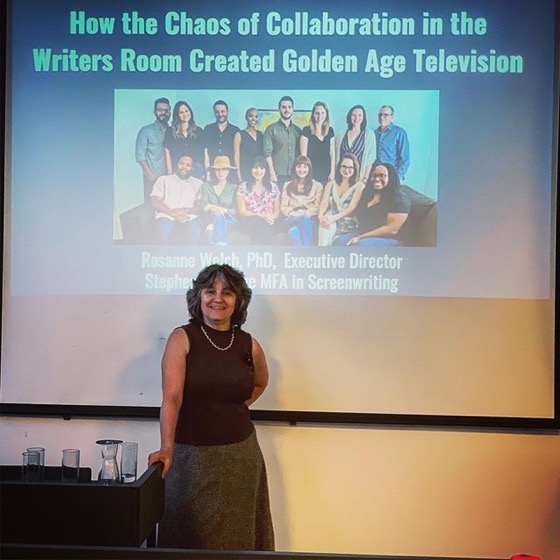
When the folks hosting the conference announced their theme as “Screen Narratives: Chaos and Order” the word ‘chaos’ immediately brought to mind writers rooms. I offered a quick history of writers rooms (the presentations are only 20 minutes long) and then quoted several current showrunners on how they compose their rooms and how they run them.
Transcript
I did a whole book on The Monkees and they had one of the first writer’s rooms in a sort of a kid’s show sitcom and so I had the chance to meet with and interview all these writers back in about three years ago who were all in their late 70s and so heard about their stories of how the room operated. It was very important to have a female. It was the first sitcom that had a femle on staff and so she added a perspective. So it started the idea that we need inclusion in our rooms. We need to hear all the different perspectives. I thought that was pretty cool. So that’s the book and the article that I wrote for Written By.
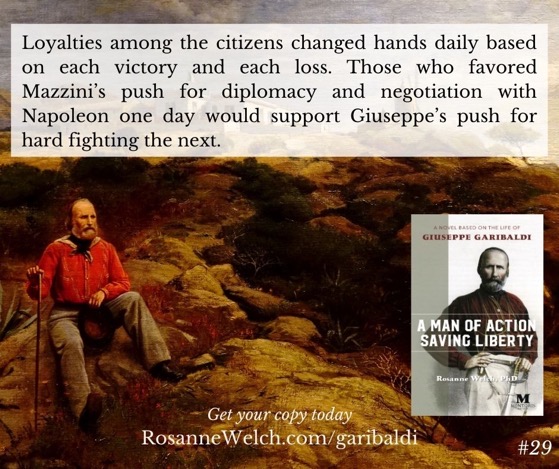
Loyalties among the citizens changed hands daily based on each victory and each loss. Those who favored Mazzini’s push for diplomacy and negotiation with Napoleon one day would support Giuseppe’s push for hard fighting the next.
Highlighting the articles in the past editions of the Journal of Screenwriting, of which I am the Book Reviews Editor. Hopefully these abstracts will entice you to did a little deeper into the history and future of screenwriting. — Rosanne
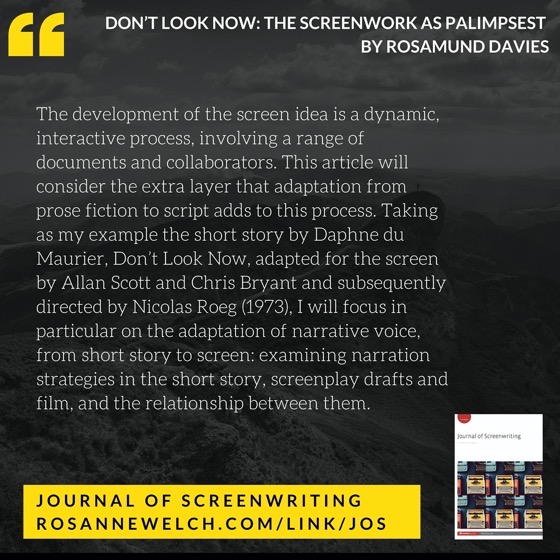
The development of the screen idea is a dynamic, interactive process, involving a range of documents and collaborators. This article will consider the extra layer that adaptation from prose fiction to script adds to this process. Taking as my example the short story by Daphne du Maurier, Don’t Look Now, adapted for the screen by Allan Scott and Chris Bryant and subsequently directed by Nicolas Roeg (1973), I will focus in particular on the adaptation of narrative voice, from short story to screen: examining narration strategies in the short story, screenplay drafts and film, and the relationship between them. My discussion will explore the relevance of Ferrer and Groden’s notion of the creative process as an ‘always virtually present’ background process, of which each element of text and avant-texte constitutes but one manifestation. It will also introduce the figure of the palimpsest, considering how it might illuminate an understanding of the screenwork as constructed through the various layers that have contributed to its genesis, producing a multiple rather than a singular entity.
The Journal of Screenwriting is an international double-blind peer-reviewed journal that is published three times a year. The journal highlights current academic and professional thinking about the screenplay and intends to promote, stimulate and bring together current research and contemporary debates around the screenplay whilst encouraging groundbreaking research in an international arena. The journal is discursive, critical, rigorous and engages with issues in a dynamic and developing field, linking academic theory to screenwriting practice.
Realizing the location would be as much a character as any person, Turner negotiated for some of the scenes to be filmed on the actual Gettysburg battlefield itself, an unprecedented National Park Service allowance, though strict federal regulations ruled out any scenes showing opposing fire or combat. In this way, Turner can be compared to David O. Selznick in terms of the way he too obsessed over every detail of the production in ways producers do not always do.
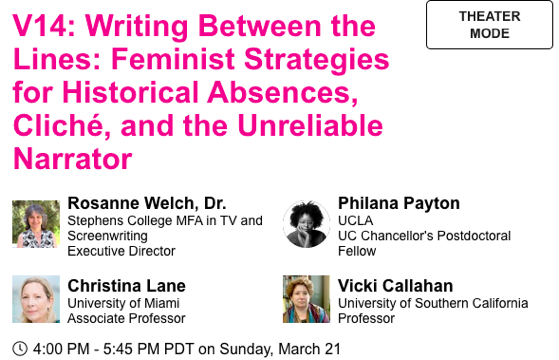
Nearly two years ago I had the pleasure of being invited to join a panel at the then upcoming SCMS (Society of Cinema and Media Studies) conference set for Seattle. As you know that was canceled due to Covid with the hopes of reconvening in Colorado in 2021. That became a virtual conference but our group decided to reapply our panel and we four were able to ‘meet’ on Zoom on Sunday and present: Writing Between the Lines: Feminist Strategies for Historical Absences, Cliché, and the Unreliable Narrator.
Here you can watch my part of the presentation,
“When Men Forget Women: The Many Ways Male Screenwriters Fail to Mention their Female Colleagues in Oral Histories”
Our intrepid panel leader, Christina Lane (author of Phantom Lady – the new biography of writer-producer Joan Harrison) kept us connected across the time. Other panel participants included Philana Payton (UCLA) who is researching the memoirs of Eartha Kitt and Vicki Callahan (USC) who covered the career of Mabel Normand. I was happy to highlight the many female screenwriters whose histories were left on the cutting room floor thanks to the unreliable narrators of their work who included directors, film reviewers, and husbands – all who left the female writers out of their own memories.
V14 Writing Between the Lines: Feminist Strategies for Historical Absences, Cliché, and the Unreliable Narrator
Chair: Christina Lane, University of Miami
Co-Chair: Vicki Callahan, University of Southern California
Vicki Callahan, University of Southern California, “Still Looking for Mabel Normand” Philana Payton, University of Southern California, “Eartha Kitt vs. Eartha Mae: Black Women, Self-Fragmentation, and the Politics of Hollywood Stardom” Rosanne Welch, Stephens College, “When Men Forget Women: The Many Ways Male Screenwriters Fail to Mention their Female Colleagues in Oral Histories” Christina Lane, University of Miami, “Alternative Writing Strategies: Notes on Discovering the ‘Women Who Knew’ Joan Harrison”
Thanks to the gracious invitation from my Screenwriting Research Network colleague Paolo Russo – and a grant he was able to procure (and in the before-Covid time) I was able to spend a week at Oxford Brookes University working with the screenwriting masters students in Paolo’s course. At the culmination of the week, I gave this lecture on how writers rooms worked in the States.
Transcript:
Kenny Johnson is a guy I worked for as an assistant. He invented The Bionic Woman — again writer’s voice. He was on staff at Universal. They came in one day and they said “Hey we’re doing the Six Million Dollar Man. We need a storyline” and he said — which is a nice tip — know the classics — we fall back on classics all the time. Sons of Anaarchy is Hamlet on motorcycles. That’s how they got pitched right? Empire is King Lear in a rap record recording studio. Seriously, knowing Shakespeare does you well in life. I promise you. The Bionic Woman that’s that’s the Bride of Frankenstein. He walked in the room and said you’ve created Frankenstein. Why doesn’t he have a bride?
Watch this entire presentation
Subscribe to Rosanne’s Channel and receive notice of each new video!
* A portion of each sale from Amazon.com directly supports our blogs ** Many of these books may be available from your local library. Check it out! † Available from the LA Public Library


![Dr. Rosanne Welch and Intellect Editor James Campbell Talk Stephens College MFA in TV and Screenwriting, The Journal of Screenwriting, and Other Work [Video] (1 hour)](https://rosannewelch.com/wp-content/uploads/2021/03/rmw-intellect-ig-live-20210324.png)
![Drs. Rosanne Welch and Dr. Sarah Clark discuss The Monkees “I’ve Got a Little Song Here” episode on the Zilch Podcast's Monkees 101 Series [Audio]](https://rosannewelch.com/wp-content/uploads/2021/03/Zilch164sm.jpg)
![05 The Monkees Writer’s Room from How The Chaos Of Collaboration in the Writers Room Created Golden Age Television [Video]](https://rosannewelch.com/wp-content/uploads/2021/03/srn-porto-05.jpg)


![Dr. Rosanne Welch Presents “When Men Forget Women: The Many Ways Male Screenwriters Fail to Mention their Female Colleagues in Oral Histories” at SCMS 2021 [Video]](https://rosannewelch.com/wp-content/uploads/2021/03/scms-vidoe-title-card.jpg)
![16 Producer, Kenny Johnson from There And Back Again: Writing and Developing for American TV [Video] (51 seconds)](https://rosannewelch.com/wp-content/uploads/2021/03/rmw-oxford-brookes-16.jpg)