Drs. Rosanne Welch and Sarah Clark discuss The Monkees “Monkees A La Carte” episode on the Zilch Podcast’s Monkees 101 Series [Audio]

It’s time for another Monkees 101, co-hosted by myself and Dr. Sarah Clark on the Zilch podcast. This time we discuss and debate “Monkees A La Carte” where the show spoofs all the classic gangster characters.  I always enjoy chatting with Dr. Clark since she’s the Monkees music uber fan to match my TV show uber fan-ness – all with a dash of the kind of research we both do in our day gigs as professors!

RMW Rosanne Signature for Web

Drs. Rosanne Welch and Sarah Clark discuss The Monkees “Monkees A La Carte” episode on the Zilch Podcast's Monkees 101 Series [Audio]

Zilch & The PTFB Team, Sarah Clark, and Tim Powers are co-hosting a Stranger Things Have Happened Zoom Listening Party on FEBRUARY 13 AT 4:00 Eastern, featuring appearances by Glenn Gretlund, Mark Kleiner, James Lee Stanley, and others!

Register Here

After Tim and Sarah plug the listening party (and get a little silly), Sarah and Rosanne discuss “Monkees a la Carte, which aired November 21, 1966. “A gangster has taken over the boys’ favorite Italian restaurant, so they disguise themselves as The Purple Flower Gang.”

Listen Now

Stephens College MFA Alumni Chase Thompson and Michael Burke Talk About Their MFA Experience on the Starcatcher Podcast [Audio Except]

In this clip from a recent Starcatcher podcast film professor (and MFA alum) and host – Chase Thompson – interviews Tech Theatre professor (and MFA alum) Michael Blake about their time as MFA candidates in our Stephens College MFA in TV and Screenwriting program. 

They both mention the great feedback they received from their writing mentors, which made me thankful for the dedication of the many marvelous mentors in our program. Then the part that made me smile the most… They each reflected on how important it was in the History of Screenwriting courses to learn about all the female screenwriters who founded Hollywood and how often those women were left out of mainstream histories of the era.

It’s a very powerful example of how history takes time — and deep research — or someone(s) will be left out.

RMW Rosanne Signature for Web

Stephens College MFA Alumni Chase Thompson and Michael Burke Talk About Their MFA Experience on the Starcatcher Podcast [Audio Except]

Join me for a conversation with Stephens College’s Director of Production, Michael Burke. A former graduate of the Stephens Theatre program, Michael talks about his path to production, his background, why Theatre majors are so good at saying thank you, and his predictions on where the road Theater is heading after the pandemic is over.

Listen to this excerpt

Listen to the entire Starcatcher Podcast Episode

From The Journal Of Screenwriting V4 Issue 1: Communication and the various voices of the screenplay text by Ann Igelström

Highlighting the articles in the past editions of the Journal of Screenwriting, of which I am the Book Reviews Editor. Hopefully these abstracts will entice you to did a little deeper into the history and future of screenwriting. — Rosanne


Communication and the various voices of the screenplay text by Ann Igelström

The aim of this article is to examine how the writer, through the means of the screenplay text, communicates the potential film to the reader. The article argues that the screenplay text’s reason for existing is to communicate the potential film, and that analysing a screenplay text through a communicational approach therefore is suitable. The author will ask what type of information is communicated, who it is that communicates and how the communication appears in the text. The article will propose a model that displays the different narrating voices that can be found in screenplay texts, and a set terminology for the narrating voices that clearly position them in relation to the text and the information they provide will be proposed. The examination of extracts from published screenplays further enables the author to identify how the use of the different narrating voices situates the reader at a certain distance from the story.

From The Journal Of Screenwriting V4 Issue 1: Communication and the various voices of the screenplay text by Ann Igelström


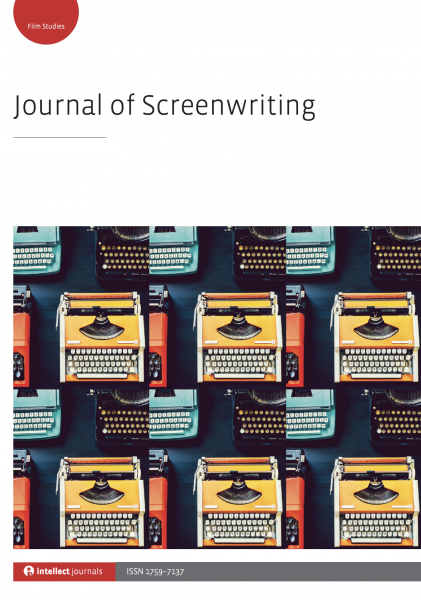
Journal of Screenwriting Cover

The Journal of Screenwriting is an international double-blind peer-reviewed journal that is published three times a year. The journal highlights current academic and professional thinking about the screenplay and intends to promote, stimulate and bring together current research and contemporary debates around the screenplay whilst encouraging groundbreaking research in an international arena. The journal is discursive, critical, rigorous and engages with issues in a dynamic and developing field, linking academic theory to screenwriting practice. 

Get your copy and subscription to the Journal of Screenwriting Today!


* A portion of each sale from Amazon.com directly supports our blogs
** Many of these books may be available from your local library. Check it out!

The Civil War On Film – 18 in a series – Mitchell was writing from the only perspective she had been taught, the myth of the benevolent slave master

The Civil War On Film - 18 in a series - Mitchell was writing from the only perspective she had been taught, the myth of the benevolent slave master

The criticism GWTW engendered then and now center on the omission of any real depiction of the horrors of slavery. Outside of Scarlett slapping Prissy on the day the maid admits knowing nothing about childbirth (despite bragging about her expertise for weeks), none of the major characters ever mistreats a slave. Critics might fault Mitchell for not doing enough historical research before undertaking the story, but Mitchell was writing from the only perspective she had been taught, the myth of the benevolent slave master, not from the perspective of an enslaved main character. Still, this first error of omission is the most blatant error.

Movies profiled in this book:

Directing on the page…On Screenwriting – 7 in a series

Directing on the page...On Screenwriting - 7 in a series


Some like to teach that writers shouldn’t “direct on the page.”

But in fact, most of the screenwriters who sell and win Oscars are people whose voice on the page is recognizable.

Those are the screenplays that sell because a person at a studio has to read the script and envision the movie. If they don’t see it, they don’t buy it.

Follow me on Instagram


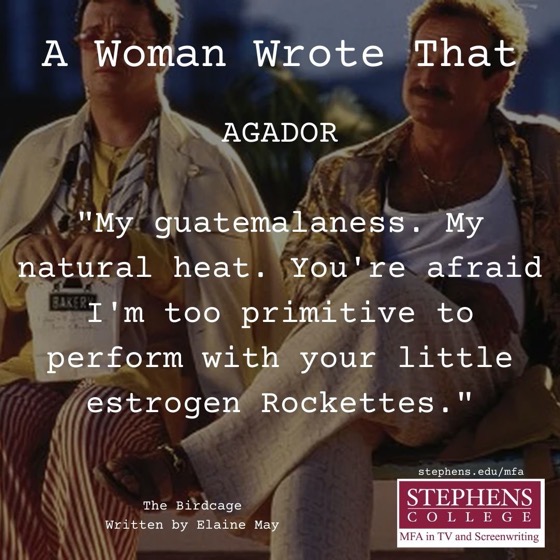
A Woman Wrote That – 14 in a series – The Birdcage (1996) Wr: Elaine May

This new “A Woman Wrote That” post is an echo of the Writers Guild campaign of a few years ago (“A Writer Wrote That”) where they noted famous movie quotes and credited the screenwriter rather than the director.  The difference here being that we will be posting lines from films written by female screenwriters.  Feel free to share! — Rosanne

AGADOR

“My guatemalaness. My natural heat. You’re afraid I’m too primitive to perform with your little estrogen Rockettes.”

An amazing article – Uncovering the History of the Triangle Shirtwaist Fire via Smithsonian Magazine

Doing some research for the Norma Rae chapter in my upcoming Women’s History of Film book (co-written with my colleague Peg Lamphier) I came upon this SMITHSONIAN MAGAZINE article by David von Drehle the author of a comprehensive book about the Triangle Shirtwaist Factory Fire. 

I like it because he talks about the real, painstaking research work he undertook to tell the whole full story some 8 decades after it happened.  People don’t often realize the work writers do to find bits of history across several archives in order to tell one story.  

So it’s a good article for that – and for reminding us that unions work to make workplaces more safe and income more equitable and I’m tired of reading things written by people who don’t seem to remember disasters like this one – is that because they largely involved the loss of female life?Rosanne Welch

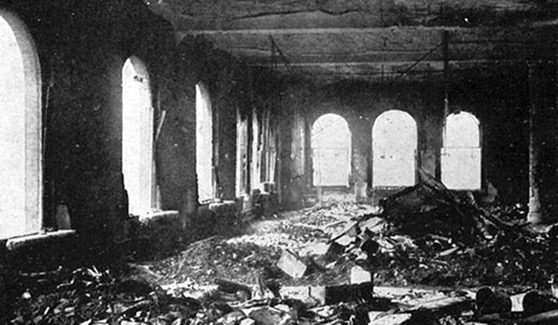
Triangle Shirtwaist Factory fire 520

On March 25, 1911, 146 workers perished when a fire broke out in a garment factory in New York City. For 90 years it stood as New York’s deadliest workplace disaster. (The Granger Collection, NYC)

Uncovering the History of the Triangle Shirtwaist Fire

The author behind the authoritative retelling of the 1911 fire describes how he researched the tragedy that killed 146 people

On March 25, 1911, a pleasant springtime afternoon, a fire broke out in a garment factory near Washington Square in New York City’s Greenwich Village. Within minutes, the entire eighth floor of the ten-story tower was full of flames. Onlookers, drawn by the column of smoke and the clamor of converging fire wagons, watched helplessly and in horror as dozens of workers screamed from the ninth-floor windows. They were trapped by flames, a collapsed fire escape and a locked door. Firefighters frantically cranked a rescue ladder, which rose slowly skyward—then stopped at the sixth floor, fully extended. Pressed by the advancing blaze, workers began leaping and tumbling to their deaths on the sidewalk. Other workers perished in the flames, still others plunged into an open elevator shaft, while behind the factory two dozen fell from the flimsy fire escape. In all, 146 workers, most of them immigrant young women and girls, perished in the Triangle Shirtwaist Factory fire. For 90 years it stood as New York’s deadliest workplace disaster.

Read the entire article — Uncovering the History of the Triangle Shirtwaist Fire

Where’s Her Movie? Physician/Author, Dr. Rebecca Lee Crumpler – 7 in a series

“Where’s HER Movie” posts will highlight interesting and accomplished women from a variety of professional backgrounds who deserve to have movies written about them as much as all the male scientists, authors, performers, and geniuses have had written about them across the over 100 years of film.  This is our attempt to help write these women back into mainstream history.  — Rosanne

Where's Her Movie? Physician/author, Dr. Rebecca Lee Crumpler - 7 in a series

Rebecca Lee Crumpler, born Rebecca Davis, (February 8, 1831 – March 9, 1895), was an American physician and author. After studying at the New England Female Medical College, in 1864 she became the first African-American woman to become a doctor of medicine in the United States.[a] Crumpler was one of the first female physician authors in the nineteenth century.[4] In 1883, she published A Book of Medical Discourses. The book has two parts that cover the prevention and cure of infertile bowel complaints, and the life and growth of human beings. Dedicated to nurses and mothers, it focuses on maternal and pediatric medical care and was among the first publications written by an African American about medicine.

Crumpler graduated from medical college at a time when very few African Americans were allowed to attend medical college or publish books. Crumpler first practiced medicine in Boston, primarily serving poor women and children. After the American Civil War ended in 1865, she moved to Richmond, Virginia, believing treating women and children was an ideal way to perform missionary work. Crumpler worked for the Freedmen’s Bureau to provide medical care for freed slaves.

She was subject to “intense racism” and sexism while practicing medicine. During this time, many men believed that a man’s brain was 10 percent bigger than a woman’s brain on average, and that a woman’s job was to act submissively and be beautiful. Because of this, many male physicians did not respect Rebecca Lee Crumpler, and would not approve her prescriptions for patients or listen to her medical opinions. Still, Rebecca Lee Crumpler persevered and worked passionately.

She later moved back to Boston to continue to treat women and children. The Rebecca Lee Pre-Health Society at Syracuse University and the Rebecca Lee Society, one of the first medical societies for African-American women, were named after her. Her Joy Street house is a stop on the Boston Women’s Heritage Trail. — Wikipedia

09 Studio Contract Writers from There And Back Again: Writing and Developing for American TV [Video] (46 seconds)

09 Studio Contract Writers from There And Back Again: Writing and Developing for American TV [Video] (46 seconds)


Thanks to the gracious invitation from my Screenwriting Research Network colleague Paolo Russo – and a grant he was able to procure (and in the before-Covid time) I was able to spend a week at Oxford Brookes University working with the screenwriting masters students in Paolo’s course. At the culmination of the week, I gave this lecture on how writers rooms worked in the States.

Transcript:

Men — because they were mostly men — worked in writer’s pools. So you got a contract with the studio to be a Universal writer and then people who ran different shows — so they’d be just like in England is today — one guy, again generally a guy, who was in charge of the show and that person would go into the writer’s pool and say “Who’s free this week? I need an episode of…Generally, it was these kinds of shows. Columbo is still kind of famous today. The NBC Mystery Movie was like that. So they go I need a Columbo who’s got an idea and somebody would raise their hand and go “I’ve got an idea” and then they would write next week’s Columbo right? So they were in a pool of writers. Out of that pool came these men who were icons of the 80s and early 90s and it was because of their originality that they began to stand out and I really can’t stress that enough.

Watch this entire presentation

Subscribe to Rosanne’s Channel and receive notice of each new video!


* A portion of each sale from Amazon.com directly supports our blogs
** Many of these books may be available from your local library. Check it out!
† Available from the LA Public Library

Event: ScriptChat with Dr. Rosanne Welch – Sunday, February 14, 2021 – 4PM PDT

I’m pleased to have been invited to be the guest on the weekly Twitter show #Scriptchat, hosted by editor Jeanne Veillette Bowerman.

On Sunday Februrary 14th at 4pm PDT we’ll be talking about behavior in a writers room, and the benefits of having an MFA in TV and Screenwriting.

If you haven’t checked in with their shows you should know that #Scriptchat brings the guests to the party so you can learn in a free, unbiased and respectful platform. Their #1 goal is to thoroughly enjoy spending an hour together every Sunday with writers working hard to improve and succeed, and they’re proud to have accomplished that time and time again, since 2009! – Rosanne

Event: ScriptChat with Dr. Rosanne Welch – Sunday, February 14, 2021 - 4PM PDT

ScriptChat with Dr. Rosanne Welch – Sunday, February 14, 2021

Wednesday, February 10, 2021
At 4 PM PDT – 5 PM PDT
TOPIC: Working in / behavior in a writers room, & benefits of having an MFA #WritingCommunity

@RosanneWelch – ##screenwriter, TV writer, novelist & Exec Dir, @stephenscollege MFA In TV & #Screenwriting

Engage via TwChat

Engage via TChat.io