From The “When Women Wrote Hollywood Archives 38: Audrey at Home: Memories of My Mother’s Kitchen by Luca Dotti

Months of research went into the creation of the essays in “When Women Wrote Hollywood.” Here are some of the resources used to enlighten today’s film lovers to the female pioneers who helped create it.

From The

Enter Audrey Hepburn’s private world in this unique New York Times bestselling biography compiled by her son that combines recollections, anecdotes, excerpts from her personal correspondence, drawings, and recipes for her favorite dishes written in her own hand, and more than 250 previously unpublished personal family photographs.

Audrey at Home offers fans an unprecedented look at the legendary star, bringing together the varied aspects of her life through the food she loved—from her childhood in Holland during World War II, to her time in Hollywood as an actress and in Rome as a wife and mother, to her final years as a philanthropist traveling the world for UNICEF.

Here are fifty recipes that reflect Audrey’s life, set in the context of a specific time, including Chocolate Cake with Whipped Cream—a celebration of liberation in Holland at the end of the war; Penne alla Vodka—a favorite home-away-from-home dish in Hollywood; Turkish-style Sea Bass—her romance with and subsequent marriage to Andrea Dotti; Boeuf à la Cuillère—Givenchy’s favorite dish, which she’d prepare when he’d visit her in Switzerland; and Mousse au Chocolat—dinner at the White House. Audrey also loved the basics: Spaghetti al Pomodoro was an all-time favorite, particularly when returning home from her travels, as was a dish of good vanilla ice cream. Each recipe is accompanied by step-by-step instructions, including variations and preparation tips, anecdotes about Audrey and her life, and a poignant collection of photographs and memorabilia.

Audrey at Home is a personal scrapbook of Audrey’s world and the things she loved best—her children, her friends, her pets. It is a life that unfolds through food, photographs, and intimate vignettes in a sophisticated and lovely book that is a must for Audrey Hepburn fans and food lovers.


Buy “When Women Wrote Hollywood” Today!


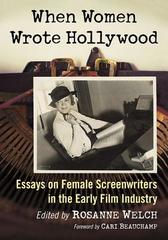
When Women Wrote Hollywood: Essays on Female Screenwriters in the Early Film Industry

Paperback Edition | Kindle Edition | Google Play Edition

Help Support Local Bookstores — Buy at Bookshop.org

* A portion of each sale from Amazon.com directly supports our blogs
** Many of these books may be available from your local library. Check it out!
† Available from the LA Public Library

When Women Wrote Hollywood: The Movies – 3 in a series – The Captive (1915) Wr: Jeannie MacPherson

An on-going series highlighting the women screenwriters of early Hollywood.

When I was first asked to create a history course for a new MFA focused on the mission of bringing more female voices and female-centric stories to Hollywood, I knew we had to start at the very beginning, when women ran Hollywood. No other course I had ever taken or been asked to teach focused on these women, some of whom I had been reading about since the summers of my childhood in Cleveland, Ohio. Back then, I went to the library once a week to collect a stack of memoirs by women I had seen interviewed on The Merv Griffin Show, women like Anita Loos and Adela Rogers St. Johns. Their stories introduced me to moguls like Louis B. Mayer or Jack Warner, who make up most of the history courses I later found in academia. Knowing better, I found most of those courses, and their accompanying textbooks, glossed over these women with a paragraph if they mentioned them at all. I conceived a course that would begin with these women who began Hollywood and culminate in research by each graduate student into the life and career of one particular early female screenwriter. That is what you find here. A collection of herstories about how these women lived, loved and created the stories that gave their audiences reasons to live and love in their own lives. — Dr. Rosanne Welch, Editor. When Women Wrote Hollywood

TheCaptive-19150pamphletfront.jpg
By Paramount Pictures – ha.com, Public Domain, Link

The Captive is an American silent-era film released on April 22, 1915. It was released on five reels.[2] The film was written, directed, edited, and produced by Cecil B. DeMille. Jesse L. Lasky was another producer and Jeanie MacPherson worked with DeMille to write the screenplay. The film is based on a play written by Cecil B. DeMille and Jeanie MacPherson. The Captive grossed just over $56,000.[3] On a budget of only $12,154.[4] Blanche Sweet stars as Sonia Martinovich, alongside House Peters who stars as Mahmud Hassan. The film details the romantic war-era plight of Montenegrin protagonist, Sonia Martinovich, and her Turkish lover, Mahmud Hassan. — Wikipedia


Buy “When Women Wrote Hollywood” Today!


When Women Wrote Hollywood: Essays on Female Screenwriters in the Early Film Industry

Paperback Edition | Kindle Edition | Google Play Edition

Help Support Local Bookstores — Buy at Bookshop.org

* A portion of each sale from Amazon.com directly supports our blogs
** Many of these books may be available from your local library. Check it out!
† Available from the LA Public Library

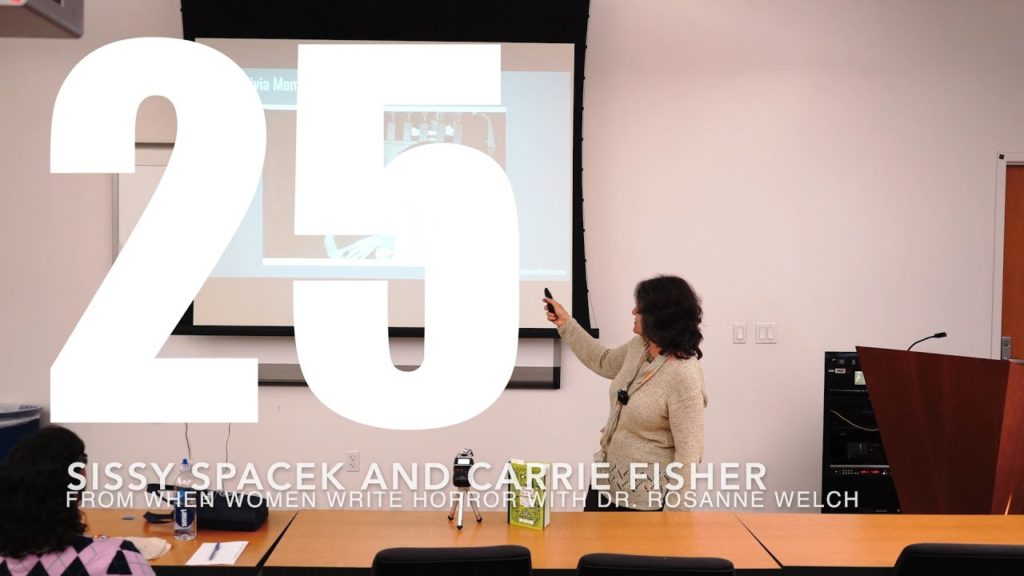
24 Carrie from When Women Write Horror with Dr. Rosanne Welch [Video] (48 seconds)

Watch this entire presentation

24 Carrie from When Women Write Horror with Dr. Rosanne Welch

Subscribe to Rosanne’s Channel and receive notice of each new video!


In honor of Halloween – and in service to my teaching philosophy —

“Words Matter. Writers Matter. Women Writers Matter.”

I presented this holiday lecture “When Women Write Horror” on Tuesday, October 29th, 2019. Researching the many, many women who have written horror stories – in novels, films and television – brought new names to my attention who I am excited to start reading. I hope you will be, too!

Transcript:

So now I want to focus for a second here also now on what happens when women are in horror films and what kind of women kind of female role models are we seeing in that world right? So, in movies, we didn’t have for a long time women doing a lot of writing so the women were represented as the characters in this piece so right? Popular, most famous, of course, being Carrie so now we’re back to Stephen King who wrote that right? So not written by a girl and the movie was actually adapted by Lawrence Cohen, but Carrie’s an interesting study in a girl revenge movie right? This is a chance for “You misused me and I’m going to get you back,” and that wasn’t something frequently that girls had a chance to get. They just got bullied and hurt and then gee who saves the day? She’s going to save her own day when she rises from the dead.

From The Journal Of Screenwriting V2 Issue 1: If it ain’t on the page, it ain’t on the stage: screenwriting, national specificity and the English-Canadian feature film by Janice Kaye and Charles H Davis

Highlighting the articles in the past editions of the Journal of Screenwriting, of which I am the Book Reviews Editor. Hopefully these abstracts will entice you to did a little deeper into the history and future of screenwriting. — Rosanne


If it ain’t on the page, it ain’t on the stage: screenwriting, national specificity and the English-Canadian feature film by Janice Kaye and Charles H Davis
  
Like other film-producing nations, Canada’s movie landscape was long ago colonized by US interests. While other nations also welcome American movies, the Canadian case is extreme: Canada has the lowest market share in the world of its own movies on its own screens. Living next to the world’s most powerful country, Canada occupies geographically, economically, linguistically and culturally a position unique in the world. The historical and ongoing predicament of the lack of success of English-Canadian feature films has been variously attributed to similarities to the United States in language and culture, lower production budgets, and weaknesses in distribution, exhibition, marketing and quality. The role of screenwriting, however, is little understood and rarely broached. In this article, we argue the importance of screenwriting in understanding national cinemas; show that it has institutional, sociological and nation-specific dimensions; and present Canada as an ideal case to begin examining such factors. The first dimension the institutional is defined by auteurism as well as the collaborative nature of production. The second the sociological is greatly affected by exclusionary networks and various levels of discrimination based on such factors as gender, ethnicity/race, age, sexuality and economic class. The nation-specific area pertains to diverse historical, cultural and institutional practices particular or exclusive to the country or region. English-Canada, for instance, experiences a unique and complex cultural policy environment. Moreover, its fractured and regional history is one that has resulted in the production of obsessively performed narratives of national identity, particularly imbricated with Qubec, the United States, Britain and France. Our analysis draws together strands of intersecting disciplines, combining film theory and history with production studies, close textual analyses, political economy and nation theory, calling for a more complete picture of the role of screenwriting in national cinemas.


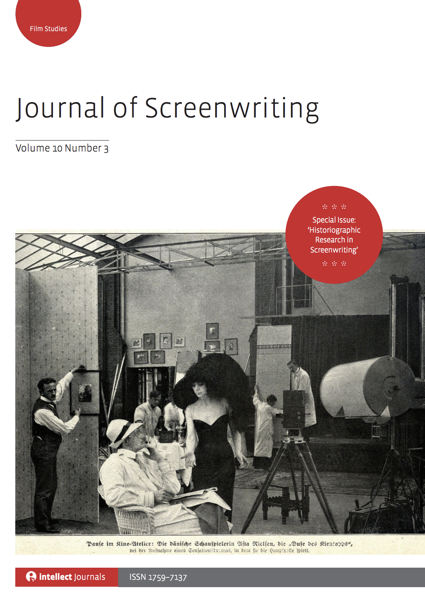
The Journal of Screenwriting is an international double-blind peer-reviewed journal that is published three times a year. The journal highlights current academic and professional thinking about the screenplay and intends to promote, stimulate and bring together current research and contemporary debates around the screenplay whilst encouraging groundbreaking research in an international arena. The journal is discursive, critical, rigorous and engages with issues in a dynamic and developing field, linking academic theory to screenwriting practice. 

Get your copy and subscription to the Journal of Screenwriting Today!


* A portion of each sale from Amazon.com directly supports our blogs
** Many of these books may be available from your local library. Check it out!

23 Edna Ferber and New York Writers from Why Researching Screenwriters (has Always) Mattered [Video] (1 minute 8 seconds)

Watch this entire presentation

23 Edna Ferber and New York Writers from Why Researching Screenwriters (has Always) Mattered

Subscribe to Rosanne’s Channel and receive notice of each new video!


Transcript:

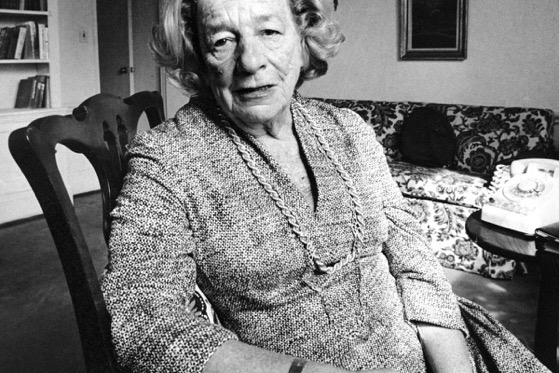
In the early days of Hollywood there were some issues because many of the people who came to write came from New York and they were very “fancy.” They thought they were better writers than that silly screenplay stuff. So when they came to Hollywood they didn’t really take their work seriously. They didn’t ask for too much credit. Edna Ferber I want to talk about for a minute. She was a novelist from New York. The quote I just think is cute. She said “A woman can look both moral and exciting if she also looks as if it was quite a struggle.” So she wrote a lot about early attitudes toward females and sex. She also wrote Showboat which is a classic film in the United States and she wrote Giant which is one of James Dean’s last films and she wrote this film Saratoga Trunk. All based on novels she had written first. She was smart enough when she came to Hollywood to require the studio to lease her novels not to buy the rights. So that they had to credit her and after a few years they couldn’t show the film anymore because it always remained in her possession and that was a brilliant idea but too many other of the New York writers didn’t take their work as seriously and didn’t bother with that idea. So it went away and we lost that chance to own our work.

A Note About This Presentation

A clip from my keynote speech at the 10th Screenwriters´(hi)Stories Seminar for the interdisciplinary Graduation Program in “Education, Art, and History of Culture”, in Mackenzie Presbyterian University, at São Paulo, SP, Brazil, focused on the topic “Why Researching Screenwriters (has Always) Mattered.” I was especially pleased with the passion these young scholars have toward screenwriting and it’s importance in transmitting culture across the man-made borders of our world.

To understand the world we have to understand its stories and to understand the world’s stories we must understand the world’s storytellers. A century ago and longer those people would have been the novelists of any particular country but since the invention of film, the storytellers who reach the most people with their ideas and their lessons have been the screenwriters. My teaching philosophy is that: Words matter, Writers matter, and Women writers matte, r so women writers are my focus because they have been the far less researched and yet they are over half the population. We cannot tell the stories of the people until we know what stories the mothers have passed down to their children. Those are the stories that last. Now is the time to research screenwriters of all cultures and the stories they tell because people are finally recognizing the work of writers and appreciating how their favorite stories took shape on the page long before they were cast, or filmed, or edited. But also because streaming services make the stories of many cultures now available to a much wider world than ever before.

Many thanks to Glaucia Davino for the invitation.


* A portion of each sale from Amazon.com directly supports our blogs
** Many of these books may be available from your local library. Check it out!
† Available from the LA Public Library

Panel Discussion: More Than A Period: Writing Girls Coming of Age Stories For TV [Video] (1 hour 27 minutes)

Panel Discussion: More Than A Period: Writing Girls Coming of Age Stories For TV

Recently, I had the honor (and the fun) of moderating another panel for the Writers Guild Foundation with a conversation centered around how we write “Girls Coming of Age” stories for television. 

Our panelists included Rheeqrheeq Chainey (The Baby Sitters Club), Sonia Kharkar (On My Block, Never Have I Ever), Ilana Peña (Creator, Diary of a Future President) and Christina Nieves (Generation), an alumna of the Stephens College MFA in TV and Screenwriting, which was the greatest pleasure of the whole event!

Panel Discussion: More Than A Period: Writing Girls Coming of Age Stories For TV [Video] (1 hour 27 minutes)Stephens College MFA. in TV and Screenwriting

For each Workshop the Stephens College MFA in TV and Screenwriting hosts a panel with the Writers Guild Foundation which takes place at the Guild offices in Los Angeles. For this August it will be on Zoom which means many more attendees can RSVP to join us – and we hope you will because this panel is extra-special. 

It’s the second year in a row we’ve been able to invite an MFA alumna to be a panelist because they have become a working writer. Last year it was Class of 2019’s Sahar Jahani (who has written for Ramy and 13 Reasons Why) and on this panel we’ll be welcoming Class of 2020’s Christina Nieves to discuss Writing Girls Coming of Age Stories thanks to her new position as a staff writer on Generation.

We hope you can join me, Dr. Rosanne Welch, Executive Director of Stephens College MFA in TV and Screenwriting as I moderate the discussion.

Panel Discussion: More Than A Period: Writing Girls Coming of Age Stories For TV - Wed, August 12, 2020, 430pm PDT

Photo by Kyle Gregory Devaras on Unsplash

More Than A Period: Writing Girls Coming of Age Stories For TV

Wednesday, August 12, 2020
4:30 PM  6:00 PM

Beyond The Book Panel - Writers Guild Foundation

We at the WGF may have hit a pause on our live events, but thanks to technology, we’re aiming to provide more access to advice and knowledge from film and TV writers while we’re all social distancing. Over the last few months, we’ve been hosting free Zoom panels about craft and all things relevant to writers.

For this session, we team up with Stephens College MFA in TV and Screenwriting for a discussion about crafting girls’ coming-of-age stories. The panel of writers will share how their shows address this formative period for its characters, how their own experiences informed their writing, and why coming-of-age stories are an endless source of stories.

Panelists:

Sonia Kharkar – Executive Story Editor, On My Block, Never Have I Ever
Christina Nieves – Staff Writer, Generation
Ilana Peña – Creator, Diary of a Future President
Moderated by Dr. Rosanne Welch, Director of Stephens College MFA in TV and Screenwriting.

From The “When Women Wrote Hollywood Archives 37: Universal Women: Filmmaking and Institutional Change in Early Hollywood

Months of research went into the creation of the essays in “When Women Wrote Hollywood.” Here are some of the resources used to enlighten today’s film lovers to the female pioneers who helped create it.

From The


Between 1912 and 1919, the Universal Film Manufacturing Company credited eleven women with directing at least 170 films, but by the mid-1920s all of these directors had left Universal and only one still worked in the film industry at all. Two generations of cinema historians have either overlooked or been stymied by the mystery of why Universal first systematically supported and promoted women directors and then abruptly reversed that policy.

In this trailblazing study, Mark Garrett Cooper approaches the phenomenon as a case study in how corporate movie studios interpret and act on institutional culture in deciding what it means to work as a man or woman. In focusing on issues of institutional change, Cooper challenges interpretations that explain women’s exile from the film industry as the inevitable result of a transhistorical sexism or as an effect of a broadly cultural revision of gendered work roles. Drawing on a range of historical and sociological approaches to studying corporate institutions, Cooper examines the relationship between institutional organization and aesthetic conventions during the formative years when women filmmakers such as Ruth Ann Baldwin, Cleo Madison, Ruth Stonehouse, Elise Jane Wilson, and Ida May Park directed films for Universal.


Buy “When Women Wrote Hollywood” Today!


When Women Wrote Hollywood: Essays on Female Screenwriters in the Early Film Industry

Paperback Edition | Kindle Edition | Google Play Edition

Help Support Local Bookstores — Buy at Bookshop.org

* A portion of each sale from Amazon.com directly supports our blogs
** Many of these books may be available from your local library. Check it out!
† Available from the LA Public Library

When Women Wrote Hollywood: The Movies – 2 in a series – Lady of the Night (1925): Story By Adela Rogers St. Johns

An on-going series highlighting the women screenwriters of early Hollywood.

When I was first asked to create a history course for a new MFA focused on the mission of bringing more female voices and female-centric stories to Hollywood, I knew we had to start at the very beginning, when women ran Hollywood. No other course I had ever taken or been asked to teach focused on these women, some of whom I had been reading about since the summers of my childhood in Cleveland, Ohio. Back then, I went to the library once a week to collect a stack of memoirs by women I had seen interviewed on The Merv Griffin Show, women like Anita Loos and Adela Rogers St. Johns. Their stories introduced me to moguls like Louis B. Mayer or Jack Warner, who make up most of the history courses I later found in academia. Knowing better, I found most of those courses, and their accompanying textbooks, glossed over these women with a paragraph if they mentioned them at all. I conceived a course that would begin with these women who began Hollywood and culminate in research by each graduate student into the life and career of one particular early female screenwriter. That is what you find here. A collection of herstories about how these women lived, loved and created the stories that gave their audiences reasons to live and love in their own lives. — Dr. Rosanne Welch, Editor. When Women Wrote Hollywood

https://www.youtube.com/watch?v=De6mZ9IAx7s

Lady of the NightLobbyCardFramed

Two women from opposite ends of the social spectrum seek love and happiness in Monta Bell’s Lady of the Night (1925). Conceived as a vehicle for rising Metro-Goldwyn star Norma Shearer to deliver a virtuoso performance — and seal her leading lady status — the film presents the actress in a dual role: as Florence, the pampered daughter of an affluent judge (Fred Esmelton), and Molly, an underprivileged dance hall girl. As fate (and a shamelessly sentimental script) would have it, both fall in love with the same man: David (Malcolm McGregor), an ambitious young inventor.TCM


Buy “When Women Wrote Hollywood” Today!


When Women Wrote Hollywood: Essays on Female Screenwriters in the Early Film Industry

Paperback Edition | Kindle Edition | Google Play Edition

Help Support Local Bookstores — Buy at Bookshop.org

* A portion of each sale from Amazon.com directly supports our blogs
** Many of these books may be available from your local library. Check it out!
† Available from the LA Public Library

23 Taking Horror Seriously from When Women Write Horror with Dr. Rosanne Welch [Video] (43 seconds)

Watch this entire presentation

23 Taking Horror Seriously from When Women Write Horror with Dr. Rosanne Welch

Subscribe to Rosanne’s Channel and receive notice of each new video!


In honor of Halloween – and in service to my teaching philosophy —

“Words Matter. Writers Matter. Women Writers Matter.”

I presented this holiday lecture “When Women Write Horror” on Tuesday, October 29th, 2019. Researching the many, many women who have written horror stories – in novels, films and television – brought new names to my attention who I am excited to start reading. I hope you will be, too!

Transcript:

It’s one of those questions you find yourself — you know people think, “Oh you’re doing a class on horror. That can’t be anything you take seriously.” Well, we have to because it’s information people are taking in. What is it making you think right? If you’re with a dude who’s scary, do you think oh yeah it was good for her. It all worked out in the end for he.r Maybe not right? Let’s reconsider how we’re taking these fictional stories into our life. So I think that’s really interesting. Twilight of course was put together by Melissa Rosenberg who had come off the tv show, Dexter. So what an interesting background before you’re gonna write about Twilight and vampire romance, she’d written about a serial killer who you know kills once a week. I don’t know but uh she made a good ton of money off that and obviously was pretty successful.

From The Journal Of Screenwriting V2 Issue 1: An evolving present within a past a history of screenwriting practices in popular Hindi cinema by Anubha Yadav

Highlighting the articles in the past editions of the Journal of Screenwriting, of which I am the Book Reviews Editor. Hopefully these abstracts will entice you to did a little deeper into the history and future of screenwriting. — Rosanne


An evolving present within a past a history of screenwriting practices in popular Hindi cinema by Anubha Yadav

This article studies the mutual and exclusive relationship between the history of popular Hindi cinema and the writing of the screenplay by finding dominant points of reference in their individual and overlapping histories. It connects the unique storytelling tradition of Hindi cinema with the subsumed creative identity of a screenwriter. To do this the article focuses on significant historical markers in Hindi cinema: the Silent era, the Talkies, the Golden era of the 1950s, the New Wave of the 1960s, the SalimJaved era of the 1970s and the New New Wave of today. The New New Wave in Hindi popular cinema aims to recognize and legitimize the presence of the story and the screenwriter. The article studies the evolution of this recent phenomenon and examines the academic and industrial variants that have led to the coming of this change in Hindi cinema.


The Journal of Screenwriting is an international double-blind peer-reviewed journal that is published three times a year. The journal highlights current academic and professional thinking about the screenplay and intends to promote, stimulate and bring together current research and contemporary debates around the screenplay whilst encouraging groundbreaking research in an international arena. The journal is discursive, critical, rigorous and engages with issues in a dynamic and developing field, linking academic theory to screenwriting practice. 

Get your copy and subscription to the Journal of Screenwriting Today!


* A portion of each sale from Amazon.com directly supports our blogs
** Many of these books may be available from your local library. Check it out!