This new “A Woman Wrote That” post is an echo of the Writers Guild campaign of a few years ago (“A Writer Wrote That”) where they noted famous movie quotes and credited the screenwriter rather than the director. The difference here being that we will be posting lines from films written by female screenwriters. Feel free to share! — Rosanne
AMBER
Ms. Stoeger, my plastic surgeon doesn’t want me doing any activity where balls fly at my nose.
I had a lot of fun on my first Twitter Chat last Sunday. Jeanne Veillette Bowerman of #Scriptchat had invited to talk about how to behave in a writers room alongside what are the benefits of an MFA in TV and Screenwriting (such as the one we offer from Stephens College).
Happily, I had just interviewed Gloria Calderon Kellet who had an MFA and who had said so astutely that no one requires that in Hollywood but taking 2 years to invest in herself and her craft meant she had material that was truly of high enough quality to offer up when future producers offered to read her work. So that was nice!
As to Twitter, I knew being short and concise is the bread and butter of Twitter but… wow… I’m clearly a much longer storyteller and kept running over the limit and having to use ellipses to extend a sentence or a thought. But folks seemed to enjoy it and even said I had ‘dropped pearls’ so that was nice to hear as well.
Check out #Scriptchat every Sunday night at 5pmPST/8pmET for more fun guests.
“Where’s HER Movie” posts will highlight interesting and accomplished women from a variety of professional backgrounds who deserve to have movies written about them as much as all the male scientists, authors, performers, and geniuses have had written about them across the over 100 years of film. This is our attempt to help write these women back into mainstream history. — Rosanne
Anna LoPizzo was a striker killed during the Lawrence Textile Strike (also known as the Bread and Roses Strike), considered one of the most significant struggles in U.S. labor history. Eugene Debs said of the strike, “The Victory at Lawrence was the most decisive and far-reaching ever won by organized labor.”[1] Author Peter Carlson saw this strike conducted by the militant Industrial Workers of the World (IWW) as a turning point. He wrote, “Wary of [a war with the anti-capitalist IWW], some mill owners swallowed their hatred of unions and actually invited the AFL to organize their workers.[2]
Anna LoPizzo’s death was significant to both sides in the struggle. Wrote Bruce Watson in his epic Bread and Roses: Mills, Migrants, and the Struggle for the American Dream, “If America had a Tomb of the Unknown Immigrant paying tribute to the millions of immigrants known only to God and distant cousins compiling family trees, Anna LoPizzo would be a prime candidate to lie in it.”[3] — Wikipedia
Thanks to the gracious invitation from my Screenwriting Research Network colleague Paolo Russo – and a grant he was able to procure (and in the before-Covid time) I was able to spend a week at Oxford Brookes University working with the screenwriting masters students in Paolo’s course. At the culmination of the week, I gave this lecture on how writers rooms worked in the States.
Transcript:
Stephen Cannell — who I’m going to talk about briefly in a second — he was in a writer’s pool and he was asked to write an episode of this one day and the reason he stood out and became then his own showrunner was because he had the craziest little idea. Rather than worry about what’s the crime this week and what’s the problem the cops are involved with, he just thought what would happen if the police were assigned to work in a police car which kept breaking down all day. Just a funny little idea which then was the theme of the whole episode. How do you do your job when you’re not providing the proper equipment and that made other people in Universal buzz about this new cool writer and they pretty much thought he had a particular voice and to me that’s the most important thing and you hear this word a thousand times. What does it mean? How do you do it? What does it prove? I’m gonna make you do a little exercise practicing that because writer’s voice is style plus opinion. You have a style of writing and you have something to say, right? That’s the theme. If you don’t have a theme you have no reason to write anything.
Watch this entire presentation
Subscribe to Rosanne’s Channel and receive notice of each new video!
* A portion of each sale from Amazon.com directly supports our blogs ** Many of these books may be available from your local library. Check it out! † Available from the LA Public Library
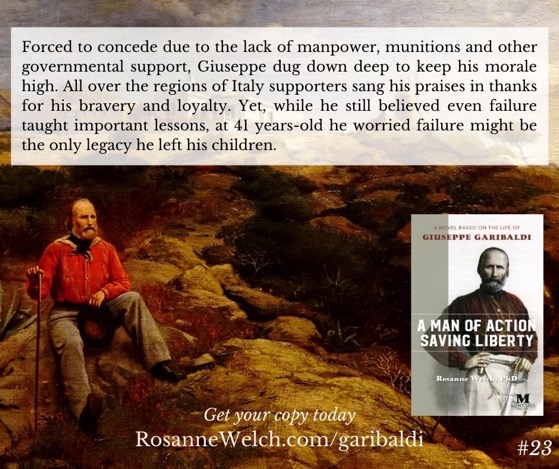
Forced to concede due to the lack of manpower, munitions and other governmental support, Giuseppe dug down deep to keep his morale high. All over the regions of Italy supporters sang his praises in thanks for his bravery and loyalty. Yet, while he still believed even failure taught important lessons, at 41 years-old he worried failure might be the only legacy he left his children.
It’s time for another Monkees 101, co-hosted by myself and Dr. Sarah Clark on the Zilch podcast. This time we discuss and debate “Monkees A La Carte” where the show spoofs all the classic gangster characters. I always enjoy chatting with Dr. Clark since she’s the Monkees music uber fan to match my TV show uber fan-ness – all with a dash of the kind of research we both do in our day gigs as professors!
Zilch & The PTFB Team, Sarah Clark, and Tim Powers are co-hosting a Stranger Things Have Happened Zoom Listening Party on FEBRUARY 13 AT 4:00 Eastern, featuring appearances by Glenn Gretlund, Mark Kleiner, James Lee Stanley, and others!
After Tim and Sarah plug the listening party (and get a little silly), Sarah and Rosanne discuss “Monkees a la Carte, which aired November 21, 1966. “A gangster has taken over the boys’ favorite Italian restaurant, so they disguise themselves as The Purple Flower Gang.”
In this clip from a recent Starcatcher podcast film professor (and MFA alum) and host – Chase Thompson – interviews Tech Theatre professor (and MFA alum) Michael Blake about their time as MFA candidates in our Stephens College MFA in TV and Screenwriting program.
They both mention the great feedback they received from their writing mentors, which made me thankful for the dedication of the many marvelous mentors in our program. Then the part that made me smile the most… They each reflected on how important it was in the History of Screenwriting courses to learn about all the female screenwriters who founded Hollywood and how often those women were left out of mainstream histories of the era.
It’s a very powerful example of how history takes time — and deep research — or someone(s) will be left out.
Join me for a conversation with Stephens College’s Director of Production, Michael Burke. A former graduate of the Stephens Theatre program, Michael talks about his path to production, his background, why Theatre majors are so good at saying thank you, and his predictions on where the road Theater is heading after the pandemic is over.
Highlighting the articles in the past editions of the Journal of Screenwriting, of which I am the Book Reviews Editor. Hopefully these abstracts will entice you to did a little deeper into the history and future of screenwriting. — Rosanne
The aim of this article is to examine how the writer, through the means of the screenplay text, communicates the potential film to the reader. The article argues that the screenplay text’s reason for existing is to communicate the potential film, and that analysing a screenplay text through a communicational approach therefore is suitable. The author will ask what type of information is communicated, who it is that communicates and how the communication appears in the text. The article will propose a model that displays the different narrating voices that can be found in screenplay texts, and a set terminology for the narrating voices that clearly position them in relation to the text and the information they provide will be proposed. The examination of extracts from published screenplays further enables the author to identify how the use of the different narrating voices situates the reader at a certain distance from the story.
The Journal of Screenwriting is an international double-blind peer-reviewed journal that is published three times a year. The journal highlights current academic and professional thinking about the screenplay and intends to promote, stimulate and bring together current research and contemporary debates around the screenplay whilst encouraging groundbreaking research in an international arena. The journal is discursive, critical, rigorous and engages with issues in a dynamic and developing field, linking academic theory to screenwriting practice.
The criticism GWTW engendered then and now center on the omission of any real depiction of the horrors of slavery. Outside of Scarlett slapping Prissy on the day the maid admits knowing nothing about childbirth (despite bragging about her expertise for weeks), none of the major characters ever mistreats a slave. Critics might fault Mitchell for not doing enough historical research before undertaking the story, but Mitchell was writing from the only perspective she had been taught, the myth of the benevolent slave master, not from the perspective of an enslaved main character. Still, this first error of omission is the most blatant error.
Subscribe to Rosanne’s Channel and receive notice of each new video!
Transcript:
…And that’s very important why, when we’re teaching screenwriting — It’s funny. People who come from a directing background like to teach that writers shouldn’t “direct on the page.” Don’t say things about where the camera should go. Don’t say how the actor is feeling. Don’t talk casually. But in fact, most of the screenwriters who sell and win Oscars are people whose voice is so recognizable. Aaron Sorkin sounds like Aaron Sorkin in everything he does. Every single piece of action is as if you are sitting there talking to him. Right? William Goldman did that. most of the big names — Nora Ephron — who was a major American female screenwriter. Their personality comes through in the lines and they do tell the director “I need this. I need this closeup. I want this moment. This is exactly what needs to happen here. Those are the screenplays that do sell because a person at a studio has to read the thing and envision the movie. If they don’t see it. They don’t buy it and they don’t make it. So that piece of advice has never worked for me.
Watch this entire presentation
A Note About This Presentation
A clip from my keynote speech at the 10th Screenwriters´(hi)Stories Seminar for the interdisciplinary Graduation Program in “Education, Art, and History of Culture”, in Mackenzie Presbyterian University, at São Paulo, SP, Brazil, focused on the topic “Why Researching Screenwriters (has Always) Mattered.” I was especially pleased with the passion these young scholars have toward screenwriting and it’s importance in transmitting culture across the man-made borders of our world.
To understand the world we have to understand its stories and to understand the world’s stories we must understand the world’s storytellers. A century ago and longer those people would have been the novelists of any particular country but since the invention of film, the storytellers who reach the most people with their ideas and their lessons have been the screenwriters. My teaching philosophy is that: Words matter, Writers matter, and Women writers matte, r so women writers are my focus because they have been the far less researched and yet they are over half the population. We cannot tell the stories of the people until we know what stories the mothers have passed down to their children. Those are the stories that last. Now is the time to research screenwriters of all cultures and the stories they tell because people are finally recognizing the work of writers and appreciating how their favorite stories took shape on the page long before they were cast, or filmed, or edited. But also because streaming services make the stories of many cultures now available to a much wider world than ever before.
Many thanks to Glaucia Davino for the invitation.
* A portion of each sale from Amazon.com directly supports our blogs ** Many of these books may be available from your local library. Check it out! † Available from the LA Public Library


![10 The Writer’s Voice from There And Back Again: Writing and Developing for American TV [Video] (1 minute 3 seconds)](https://rosannewelch.com/wp-content/uploads/2021/02/rmw-oxford-brookes-10.png)
![Drs. Rosanne Welch and Sarah Clark discuss The Monkees “Monkees A La Carte” episode on the Zilch Podcast’s Monkees 101 Series [Audio]](https://rosannewelch.com/wp-content/uploads/2021/01/RMW-Rosanne-Signature-for-Web.png)
![Drs. Rosanne Welch and Sarah Clark discuss The Monkees “Monkees A La Carte” episode on the Zilch Podcast's Monkees 101 Series [Audio]](https://rosannewelch.com/wp-content/uploads/2021/02/zilch-162.jpg)
![Stephens College MFA Alumni Chase Thompson and Michael Burke Talk About Their MFA Experience on the Starcatcher Podcast [Audio Except]](https://rosannewelch.com/wp-content/uploads/2021/02/starcatcher-106-burke-mfa.jpg)

![48 Directing On The Page from Why Researching Screenwriters Has Always Mattered [Video] (1 minute 3 seconds)](https://rosannewelch.com/wp-content/uploads/2021/02/rmw-sao-paolo-48.png)