“The edict read: “The council of war, invoking divine aid, condemns by default Garibaldi to the penalty of ignominious death, and declares him to be exposed to public vengeance as an enemy of the country and the state, subject to all the pains and penalties imposed by the royal laws against bandits of the first catalogue in which the condemned is placed.””
Category: Education
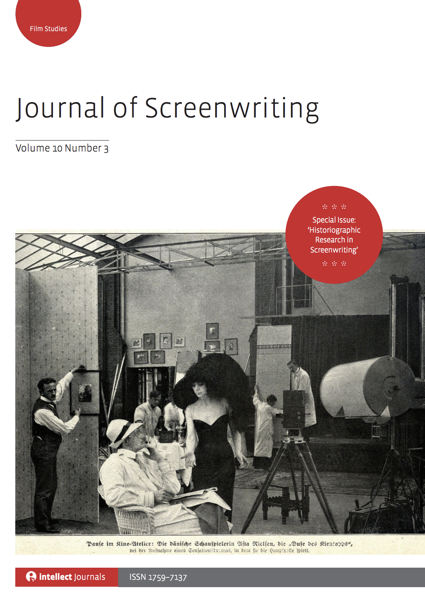
From The Journal Of Screenwriting V2 Issue 2: Some attitudes and trajectories in screenwriting research by Steven Maras
Highlighting the articles in the past editions of the Journal of Screenwriting, of which I am the Book Reviews Editor. Hopefully these abstracts will entice you to did a little deeper into the history and future of screenwriting. — Rosanne
Some attitudes and trajectories in screenwriting research by Steven Maras
An edited extract from a keynote address at the third Screenwriting Research Network conference, ‘Screenwriting Research: History, Theory and Practice’, at the University of Copenhagen in 2010,1 this piece focuses on what I have termed the ‘object problem’ in screenwriting research. I pay specific attention to how we might address the object problem by thinking about different attitudes and trajectories in screenwriting research.
The Journal of Screenwriting is an international double-blind peer-reviewed journal that is published three times a year. The journal highlights current academic and professional thinking about the screenplay and intends to promote, stimulate and bring together current research and contemporary debates around the screenplay whilst encouraging groundbreaking research in an international arena. The journal is discursive, critical, rigorous and engages with issues in a dynamic and developing field, linking academic theory to screenwriting practice.
Get your copy and subscription to the Journal of Screenwriting Today!
* A portion of each sale from Amazon.com directly supports our blogs
** Many of these books may be available from your local library. Check it out!
The Civil War On Film – 3 in a series – “…films doomed to be mediocre at best and ideologically horrifying at worst.”
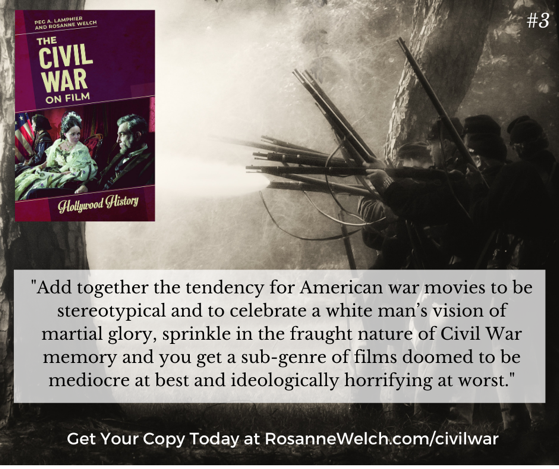
“Add together the tendency for American war movies to be stereotypical and to celebrate a white man’s vision of martial glory, sprinkle in the fraught nature of Civil War memory and you get a sub-genre of films doomed to be mediocre at best and ideologically horrifying at worst.”
Movies profiled in this book:
Recent Excellent Review of “When Women Wrote Hollywood” in The Journal of American Culture
I’m happy to say our book just received a review in The Journal of American Culture.
The reviewer (from the University College of North Manitoba, Canada) singled out several chapters for being outstanding for various reasons. They found Amelia Phillips’s chapter on Jeanne Macpherson to demonstrate “exacting research”, Julie Berkobien’s chapter on Francis and Albert Hackett to be “beautifully crafted” and Chase Thompson’s chapter on Lois Weber to be “trailblazing”. They found that Pamela Scott gives “thorough and measured” coverage to the scripts of Sarah Y. Mason and Victor Heerman; Laura Kirk “comprehensively” examines Sam and Bella Spewak’s signature style; Kelly Zinge authored “carefully detailed discussion” of Lillian Hellman’s confrontation with the Blacklist, and that Elizabeth Dwyer’s work on Dorothy Parker is “riveting.”
Congratulations to all the contributors to our book!
Buy “When Women Wrote Hollywood” Today!
Paperback Edition | Kindle Edition | Google Play Edition
Help Support Local Bookstores — Buy at Bookshop.org
* A portion of each sale from Amazon.com directly supports our blogs
** Many of these books may be available from your local library. Check it out!
† Available from the LA Public Library
33 Get Out and The Last Boy from When Women Write Horror with Dr. Rosanne Welch [Video] (1 minute 28 seconds)
Watch this entire presentation
Subscribe to Rosanne’s Channel and receive notice of each new video!
Transcript:
Now, I think it’s really important to think about also another thing that we use in our class. Jordan Peele, right? He wrote which horror film? Get Out. Thank you very much. He got an Oscar for writing that. That’s how different, unique, and creative that film is. He gave us not a final girl because if you haven’t seen the movie she’s a bad guy. Spoiler alert. He gave us the final guy. This is a movie about the final guy — the guy who survives where no one else survived before right? He sees the horror that’s happening and he uses his brain to get out of it. So I had to think about that. So does he qualify for these definitions? He is the last one left standing. All the other people who came before him have been incorporated you know white people have been put into their brains and it’s weird. Ehhh, I don’t know if he’s definitely young he’s not necessarily innocent because he and his girlfriend have definitely had sex right but he’s a really good nice guy so maybe he qualifies as innocent. I don’t know and then we think about in the end — spoiler alert — he kills the bad girl by strangling her right. Is that a feminine way to kill people? Poisoning is more a feminine thing. I don’t know but it’s not a masculine way either. So it’s a little bit right a little bit. Maybe it’s not the perfect definition but he’s definitely the last guy standing when we get to the end of this movie. Which is quite brilliant.
A Note About This Presentation
A clip from my keynote speech at the 10th Screenwriters´(hi)Stories Seminar for the interdisciplinary Graduation Program in “Education, Art, and History of Culture”, in Mackenzie Presbyterian University, at São Paulo, SP, Brazil, focused on the topic “Why Researching Screenwriters (has Always) Mattered.” I was especially pleased with the passion these young scholars have toward screenwriting and it’s importance in transmitting culture across the man-made borders of our world.
To understand the world we have to understand its stories and to understand the world’s stories we must understand the world’s storytellers. A century ago and longer those people would have been the novelists of any particular country but since the invention of film, the storytellers who reach the most people with their ideas and their lessons have been the screenwriters. My teaching philosophy is that: Words matter, Writers matter, and Women writers matte, r so women writers are my focus because they have been the far less researched and yet they are over half the population. We cannot tell the stories of the people until we know what stories the mothers have passed down to their children. Those are the stories that last. Now is the time to research screenwriters of all cultures and the stories they tell because people are finally recognizing the work of writers and appreciating how their favorite stories took shape on the page long before they were cast, or filmed, or edited. But also because streaming services make the stories of many cultures now available to a much wider world than ever before.
Many thanks to Glaucia Davino for the invitation.
* A portion of each sale from Amazon.com directly supports our blogs
** Many of these books may be available from your local library. Check it out!
† Available from the LA Public Library
Podcast: Play in new window | Download
Subscribe: RSS
“A Man Of Action Saving Liberty: A Novel Based On The Life Of Giuseppe Garibaldi” – 7 in a series
“At five feet five with blond hair and blue eyes, Garibaldi was visually more Greek than Italian, but Italian women were drawn to him all the same, especially when those who supported a united Italy understood he was on their side. Teresita Cassamiglia and her mother, Caterina Boscovich, who owned the Osteria del Colombo in Genoa, were among the many women who helped Giuseppe. Ignoring the danger that could come from aiding and abetting revolutionaries, they housed Giuseppe at their Inn between naval journeys, slyly seeking out other potential converts to Mazzini’s Young Italy to send his way.”
From The Journal Of Screenwriting V2 Issue 2: Re-writing Paul Laverty’s screenplay – The Wind that Shakes the Barley (2006) by Jill Nelmes
Highlighting the articles in the past editions of the Journal of Screenwriting, of which I am the Book Reviews Editor. Hopefully these abstracts will entice you to did a little deeper into the history and future of screenwriting. — Rosanne
Re-writing Paul Laverty’s screenplay – The Wind that Shakes the Barley (2006) by Jill Nelmes
This article analyses two drafts of Paul Laverty’s screenplay The Wind that Shakes the Barley (2004b, 2005), pointing out that the changes from the first draft to the second draft focus on a single protagonist and emphasize the narrative drive, prioritizing these over informational detail and scenes which do not have a clear narrative function. In this study, I argue, re-writing acts as a refining and filtering process, in which only the essential parts of the story are retained while the model of ‘cause’ then ‘effect’ is applied to ensure the linearity of the action.
The Journal of Screenwriting is an international double-blind peer-reviewed journal that is published three times a year. The journal highlights current academic and professional thinking about the screenplay and intends to promote, stimulate and bring together current research and contemporary debates around the screenplay whilst encouraging groundbreaking research in an international arena. The journal is discursive, critical, rigorous and engages with issues in a dynamic and developing field, linking academic theory to screenwriting practice.
Get your copy and subscription to the Journal of Screenwriting Today!
* A portion of each sale from Amazon.com directly supports our blogs
** Many of these books may be available from your local library. Check it out!
The Civil War On Film – 2 in a series – “…movies not only wear history at best as a loose garment…”
As historian Thomas Cripps said, “movies not only wear history at best as a loose garment, but their makers care more for following well tested recipes for making good grosses than for the niceties of history” (Cripps 1995). There is no movie genre where this is this more true than Civil War movies.
Movies profiled in this book:
Write the emotions you know… via Instagram
Writers are often told to “write what you know.”
Instead, we should write the emotions we know.
These are universal.
Reel Sisters of the Diaspora Film Festival Script Breakdown Session with Dr. Rosanne Welch and Dawn Comer Jefferson – Sunday, October 25, 2020
As the Stephens College MFA in TV and Screenwriting is one of the sponsors of the Reel Sisters of the Diaspora Film Festival I’ll be hosting (along with MFA mentor Dawn Comer Jefferson) a free script breakdown and Q & A with Nicole Ballivian (writer-director) for her 10 minute short Joe and the Shawl described as the story of “an adorable tow truck driver who really digs Kelli, a fellow North Carolinian, when he meets her as he changes her dead car battery. But Joe’s interest takes a sharp right turn when he learns that Kelli is a Muslim.”
If you’d like to virtually attend the event, register and join us
Sunday, October 25th
1pm-2:30pm (Pacific Time)
FREE
Register Here
For more information on the Joe and the Shawl, check out the film’s website
Joe & The Shawl: Bernie Sanders Teaser from Nicole Ballivian on Vimeo.
Joe & The Shawl – Official Trailer from Nicole Ballivian on Vimeo.