Script contributor Dr. Rosanne Welch shines a light on Jeanie MacPherson, a trailblazing screenwriter from the silent era who would eventually come to write a bulk of famed Hollywood mogul Cecil B. DeMille’s box office hits.
As with many other female Silent Era screenwriters Jeanie Macpherson began her career as an actress (appearing in over 147 films). Then she became a writer/director at Universal (writing 54 films) and eventually met Cecil B. DeMille, for whom she would write the bulk of his box office successes. In 1927, Macpherson became one of only three women, the other two being Mary Pickford and Bess Meredyth (more on her in a future column) who helped found the Academy of Motion Picture Arts and Sciences (along with thirty-three male screenwriters). She was also a suffragette – and a pilot in those early days of aviation when, like the new world of motion pictures, even the skies were open to female trailblazers.
If you go pre-90210 you’re going to find that teenagers were more often in comedies and more often in kind of doing silly things and very superficial things — getting a date — things like that and from 90210 on they had real lives and real things could happen to them and real problems happen to them and as you said continue through Euphoria exactly exactly. You don’t do a teen show these days that doesn’t look at their lives more in-depth. I guess that’s what I’m going to say.
It’s always fun to sit down with students and share stories about entering the television industry and how things work at all stages and I had that opportunity the other day.
Daniela Torres, a just-graduated (Congratulations!) student of the Columbia College Semester in LA program asked me to guest on a podcast she had recently begun hosting with another college student she met during her internship (good example of networking in action!).
We could have talked all morning (the benefit of a 3 hour class session) but we held it to about an hour and fifteen minutes or so. Hopefully, along the way I answered some questions you might have about how the business works. So often it amounts to working hard at being a better writer and gathering a group of other talented, hard-working people around you so you can all rise together.
Dr. Rosanne Welch is a television writer with credits that include Beverly Hills 90210, Picket Fences, ABCNEWS: Nightline and Touched by an Angel. She also teaches Television Writing and the Art of Film at San Jose State University.
Rosanne discusses what made shows like Beverly Hills 90210 compelling, what to do and not to do when attempting to pitch a show to broadcast or streaming, what most young writers neglect in their writing process, and much more!
The Courier Thirteen Podcast is available on YouTube, Spotify, Apple Podcasts, SoundCloud, and Audible.
Highlighting the articles in the past editions of the Journal of Screenwriting, of which I am the Book Reviews Editor. Hopefully these abstracts will entice you to did a little deeper into the history and future of screenwriting. — Rosanne
This article provides an overview of the resources available at the Writers Guild Foundation Shavelson Webb Library in Los Angeles, California. Included is a history of the library, an explanation of the Writers Guild Foundation’s Archive, and discussion of the library and archive’s extensive holdings. The author details resources available online. The article also offers information on how to prepare for a visit to the library and best practices when conducting research or using the Writers Guild Foundation Library and Archive for scholarly or creative work.
The Journal of Screenwriting is an international double-blind peer-reviewed journal that is published three times a year. The journal highlights current academic and professional thinking about the screenplay and intends to promote, stimulate and bring together current research and contemporary debates around the screenplay whilst encouraging groundbreaking research in an international arena. The journal is discursive, critical, rigorous and engages with issues in a dynamic and developing field, linking academic theory to screenwriting practice.
Thanks to the gracious invitation from my Screenwriting Research Network colleague Paolo Russo – and a grant he was able to procure (and in the before-Covid time) I was able to spend a week at Oxford Brookes University working with the screenwriting masters students in Paolo’s course. At the culmination of the week, I gave this lecture on how writers rooms worked in the States.
Transcript:
There was this violin and I kept sitting in the room thinking it took 26 years to make this violin and it’s really important. You give it to the kid soon. Throw it away and make a new one. Something’s wrong with the wood right? I said this is my problem is you know he said I’ll fix the problem. The angel will have given this guy the wood and therefore he can’t throw it away right? He’s like well 26 years and making his violin, the angel handed him a crap piece of wood okay? I need to start again. This is — I need a reason why you can’t throw this piece of wood away and it’s a Christmas episode. There’s only one piece of wood an angel can give me that I won’t throw away on Christmas eve. What is that?
Watch this entire presentation
Subscribe to Rosanne’s Channel and receive notice of each new video!
* A portion of each sale from Amazon.com directly supports our blogs ** Many of these books may be available from your local library. Check it out! † Available from the LA Public Library
So those characters became three-dimensional human beings for the five years he ran the show and then he left and a couple of people who mostly worked in — more that’s the word I want — more soap opera kind of things and I like soap operas. I don’t think they’re bad but they’re a different style and they turn the show into who is having sex with who each week but it stayed in the air for another three or four years because of the foundation, the love, for those original characters that the audience had. They just kept wanting to watch them even if the stories got less and less interesting and that’s the power of what he put together in those first two years. So truly believing and caring about those characters — which meant he truly believed and cared about the writing — the stories had to be real and I think that showed. That’s why I mean come on why do you guys still know what Beverly Hills 90210 is? You weren’t around in the 90s right but it’s been around and rerun. There’s a lot of other teenage shows but that one sticks right? There’s a reason for that.
It’s always fun to sit down with students and share stories about entering the television industry and how things work at all stages and I had that opportunity the other day.
Daniela Torres, a just-graduated (Congratulations!) student of the Columbia College Semester in LA program asked me to guest on a podcast she had recently begun hosting with another college student she met during her internship (good example of networking in action!).
We could have talked all morning (the benefit of a 3 hour class session) but we held it to about an hour and fifteen minutes or so. Hopefully, along the way I answered some questions you might have about how the business works. So often it amounts to working hard at being a better writer and gathering a group of other talented, hard-working people around you so you can all rise together.
Dr. Rosanne Welch is a television writer with credits that include Beverly Hills 90210, Picket Fences, ABCNEWS: Nightline and Touched by an Angel. She also teaches Television Writing and the Art of Film at San Jose State University.
Rosanne discusses what made shows like Beverly Hills 90210 compelling, what to do and not to do when attempting to pitch a show to broadcast or streaming, what most young writers neglect in their writing process, and much more!
The Courier Thirteen Podcast is available on YouTube, Spotify, Apple Podcasts, SoundCloud, and Audible.
Thanks to the gracious invitation from my Screenwriting Research Network colleague Paolo Russo – and a grant he was able to procure (and in the before-Covid time) I was able to spend a week at Oxford Brookes University working with the screenwriting masters students in Paolo’s course. At the culmination of the week, I gave this lecture on how writers rooms worked in the States.
Transcript:
Let me talk briefly about the kinds of things you learn in a room. One of the things you should take a class in is psychology because reading other people and managing how you deal with them — when you figure out their personalities either love you or don’t love you — but you have to work with them for the next three years because contracts are three years long. So you have to work around them. In this particular case. we were doing an episode about a gentleman, sadly, who was dying of AIDS and coming home for Christmas to tell his parents that he was both gay and dying of AIDS and what happened was the writer who was doing it was very fond of himself and didn’t like to be told anything was wrong with his stories, but your job in the room is to make all the stories as good as possible because if the show gets canceled you all lose your job. So I knew that he didn’t like criticism and he was higher on the hierarchy than I was right? He was a higher rank producer. I was still a co-editor or something like that at the time and I’m sitting in the room and his problem was — this is a story about angels who came into your life and told you how you were messing it up and please fix it — so the father was a violin maker and he’s going to give his son a violin he’d been working on since the boy was born. So that’s about 26 years and it was still not good and he really wanted to give the kid the violin because there was a metaphor that if you played violin again maybe he wouldn’t be gay. I’m not really sure I agree with that but anyway…
Watch this entire presentation
Subscribe to Rosanne’s Channel and receive notice of each new video!
* A portion of each sale from Amazon.com directly supports our blogs ** Many of these books may be available from your local library. Check it out! † Available from the LA Public Library
Highlighting the articles in the past editions of the Journal of Screenwriting, of which I am the Book Reviews Editor. Hopefully these abstracts will entice you to did a little deeper into the history and future of screenwriting. — Rosanne
This article proposes a new approach to script development modelled after lean software development practices and entrepreneurial startup principles. First, it argues that the Hollywood mode of production and its methods of project development, when applied to microbudget film-making, are inherently wasteful and fail in the face of extreme uncertainty and unpredictability. Second, it argues that entrepreneurial screenwriters and writer/film-makers can adopt lean thinking in order to eliminate waste from their creative labour and enhance learning at every stage of development and production, adding value for their audience. Finally, it argues that inexperienced writer/film-makers are particularly susceptible to the false security of the ‘blueprint’ metaphor, often clinging to an original plan even as it fails them. The flexibility inherent to lean thinking, on the other hand, not only reduces waste but also enhances creativity and collaboration, increasing a project’s chances of success.
The Journal of Screenwriting is an international double-blind peer-reviewed journal that is published three times a year. The journal highlights current academic and professional thinking about the screenplay and intends to promote, stimulate and bring together current research and contemporary debates around the screenplay whilst encouraging groundbreaking research in an international arena. The journal is discursive, critical, rigorous and engages with issues in a dynamic and developing field, linking academic theory to screenwriting practice.
Subscribe to Rosanne’s Channel and receive notice of each new video!
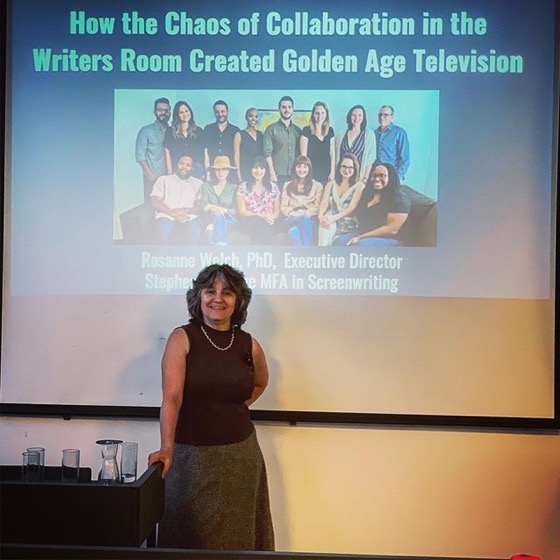
When the folks hosting the conference announced their theme as “Screen Narratives: Chaos and Order” the word ‘chaos’ immediately brought to mind writers rooms. I offered a quick history of writers rooms (the presentations are only 20 minutes long) and then quoted several current showrunners on how they compose their rooms and how they run them.
Transcript:
…and then there were many many stories in this one particularly, very quickly, there were people in the room who wanted to shoot down your ideas. Again reading the room and I had an idea about dealing with teenage young men who were fathers and lived in gangs and they had to make a commitment to their real family not their gang family. I knew that someone else in the room would not want me to have the extra script that year because that’s a nice chunk of money he would rather have. So my joke is I followed my executive producer into the bathroom because she was a woman and so was I and then I pitched her while we were washing our hands. So that when we walked back in the room, she already liked the idea and for someone else to shoot it down would be to say she had a bad idea and therefore I got whatever. So reading the room has always been a very important lesson. As well as remembering the doctors have power. Whenever you think about side characters, think about making them ethnic because that’s really important and then these are just the things that I learned from the room. You have to do research. You have to think about your nightmares. You have to speak up. I teach my female students this all the time. Please speak up. Don’t wait for the boys to give you a moment because they won’t and then I learned a lot and then I will briefly just say teachers make great writers because they do and collaboration doesn’t just happen in tv right because these guys collaborated on those films we have to recognize that so collaboration and chaos makes good quality presentations. Thank you.
…and I always say Beverly Hills 90210 is an excellent study for people in how who the showrunner is makes a difference because that show was created as a pilot by Darren Starr who’s still famously writing pilots and then he left and the show was run, managed on a daily basis by Chuck Rosen. If you look at the pilot of 90210, it’s really a bunch of rich kids and fancy clothes hanging out at the beach having bonfires. There’s not a whole lot of meat to it. Two Ohio kid’s dad moves to town because he’s an accountant and he’s going to work in Beverly Hills and so their midwest values meet Beverly hills values and that’s all you get. Chuck took over and he was the child of a surgeon at Cedars-Sinai. He grew up in Beverly Hills. So those children became real three-dimensional human beings because one of the issues is how do you — how do you connect to a character that’s uber-rich. Like they have no problems because they’re rich and that’s what most people would think because we’re not all rich but he knew kids who had drug problems. He knew kids whose parents had drug problems and therefore weren’t there for them. So he looked at the fact that it doesn’t matter how much money you have, if there’s a problem in your family, it still makes you vulnerable and that is going to make an audience interested in you.
It’s always fun to sit down with students and share stories about entering the television industry and how things work at all stages and I had that opportunity the other day.
Daniela Torres, a just-graduated (Congratulations!) student of the Columbia College Semester in LA program asked me to guest on a podcast she had recently begun hosting with another college student she met during her internship (good example of networking in action!).
We could have talked all morning (the benefit of a 3 hour class session) but we held it to about an hour and fifteen minutes or so. Hopefully, along the way I answered some questions you might have about how the business works. So often it amounts to working hard at being a better writer and gathering a group of other talented, hard-working people around you so you can all rise together.
Dr. Rosanne Welch is a television writer with credits that include Beverly Hills 90210, Picket Fences, ABCNEWS: Nightline and Touched by an Angel. She also teaches Television Writing and the Art of Film at San Jose State University.
Rosanne discusses what made shows like Beverly Hills 90210 compelling, what to do and not to do when attempting to pitch a show to broadcast or streaming, what most young writers neglect in their writing process, and much more!
The Courier Thirteen Podcast is available on YouTube, Spotify, Apple Podcasts, SoundCloud, and Audible.
Thanks to the gracious invitation from my Screenwriting Research Network colleague Paolo Russo – and a grant he was able to procure (and in the before-Covid time) I was able to spend a week at Oxford Brookes University working with the screenwriting masters students in Paolo’s course. At the culmination of the week, I gave this lecture on how writers rooms worked in the States.
Transcript:
Touched by an Angel I spent a lot of time on. I actually started my career as a high school teacher at an all-girl academy which is funny because now I teach at an all-girl college and then I was a receptionist and then a writer’s assistant. So these are the stages of how you get into a writer’s room. Either you have to have a friend who’s a writer or you get an agent which is almost nearly impossible without having a job already or you become the friend to writers by getting a job working for them in some fashion. I actually know someone who got a job because he was the ski instructor to the writer’s wife and he gave the wife a script which she gave her husband and he liked it enough he hired the ski instructor to be a writer on his show. So however you can get in the face of writers is an important thing. That’s what internships are very good at. That’s what interviewing people — if you have a school newspaper or someplace you can get published with something or a blog and you offer to interview someone, you can make an introduction. That’s really an important thing. So I went through — all these are a bunch of shows I was an assistant on. Then I was a freelance writer, which is what we do in LA and then I was hired full-time on Touched by an Angel.
Watch this entire presentation
Subscribe to Rosanne’s Channel and receive notice of each new video!
* A portion of each sale from Amazon.com directly supports our blogs ** Many of these books may be available from your local library. Check it out! † Available from the LA Public Library

![12 90210 & Teenage Lives from Worry and Wonder | The Courier Thirteen Podcast [Video]](https://rosannewelch.com/wp-content/uploads/2021/08/rmw-courier-13-12.jpg)


![38 More On Working Well With Others from There And Back Again: Writing and Developing for American TV [Video]](https://rosannewelch.com/wp-content/uploads/2021/08/rmw-oxford-brookes-38.jpg)
![11 Even More On Beverly Hills 90210 from Worry and Wonder | The Courier Thirteen Podcast [Video]](https://rosannewelch.com/wp-content/uploads/2021/08/rmw-courier-13-11.jpg)
![37 Working Well With Others from There And Back Again: Writing and Developing for American TV [Video]](https://rosannewelch.com/wp-content/uploads/2021/08/rmw-oxford-brookes-37.jpg)

![24 Conclusion from How The Chaos Of Collaboration in the Writers Room Created Golden Age Television [Video]](https://rosannewelch.com/wp-content/uploads/2021/08/srn-porto-24.jpg)

![10 More On Beverly Hills 90210 from Worry and Wonder | The Courier Thirteen Podcast | Episode # 29 [Video]](https://rosannewelch.com/wp-content/uploads/2021/08/rmw-courier-13-10.jpg)
![36 My Own Writing Adventure from There And Back Again: Writing and Developing for American TV [Video]](https://rosannewelch.com/wp-content/uploads/2021/08/rmw-oxford-brookes-36.jpg)