05 The Monkees Writer’s Room from How The Chaos Of Collaboration in the Writers Room Created Golden Age Television [Video]

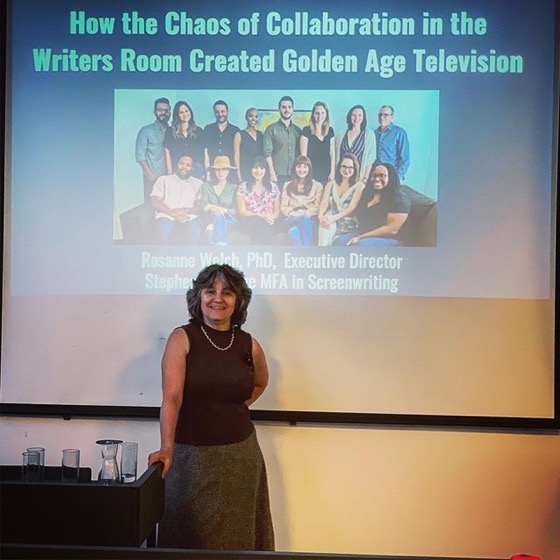
With the full recording of “How The Chaos Of Collaboration in the Writers Room Created Golden Age Television”

05 The Monkees Writer's Room from How The Chaos Of Collaboration in the Writers Room Created Golden Age Television [Video]

Subscribe to Rosanne’s Channel and receive notice of each new video!


When the folks hosting the conference announced their theme as “Screen Narratives: Chaos and Order” the word ‘chaos’ immediately brought to mind writers rooms. I offered a quick history of writers rooms (the presentations are only 20 minutes long) and then quoted several current showrunners on how they compose their rooms and how they run them.

Transcript

I did a whole book on The Monkees and they had one of the first writer’s rooms in a sort of a kid’s show sitcom and so I had the chance to meet with and interview all these writers back in about three years ago who were all in their late 70s and so heard about their stories of how the room operated. It was very important to have a female. It was the first sitcom that had a femle on staff and so she added a perspective. So it started the idea that we need inclusion in our rooms. We need to hear all the different perspectives. I thought that was pretty cool. So that’s the book and the article that I wrote for Written By.

For more information on the Screenwriting Research Network, visit

Screenwriting Research Network Conference, Porto, Portugal, All Sessions


Ready to present my talk yesterday at the Screenwriting Research Conference here in Porto, Portugal via Instagram

Follow me on Instagram


* A portion of each sale from Amazon.com directly supports our blogs
** Many of these books may be available from your local library. Check it out!

From The Journal Of Screenwriting V4 Issue 2: The screenwork as palimpsest by Rosamund Davies

Highlighting the articles in the past editions of the Journal of Screenwriting, of which I am the Book Reviews Editor. Hopefully these abstracts will entice you to did a little deeper into the history and future of screenwriting. — Rosanne


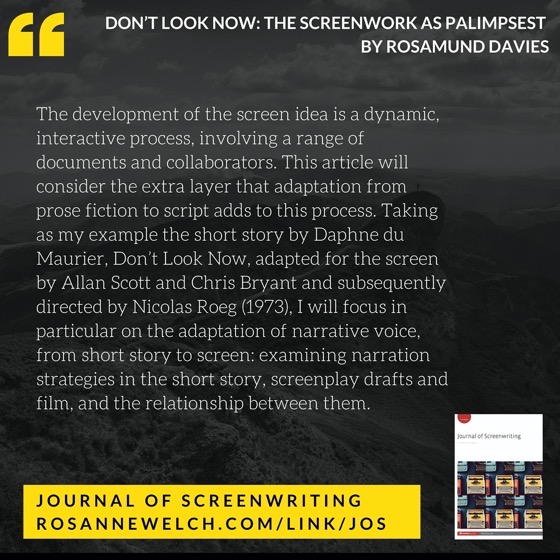
Don’t Look Now: The screenwork as palimpsest by Rosamund Davies

The development of the screen idea is a dynamic, interactive process, involving a range of documents and collaborators. This article will consider the extra layer that adaptation from prose fiction to script adds to this process. Taking as my example the short story by Daphne du Maurier, Don’t Look Now, adapted for the screen by Allan Scott and Chris Bryant and subsequently directed by Nicolas Roeg (1973), I will focus in particular on the adaptation of narrative voice, from short story to screen: examining narration strategies in the short story, screenplay drafts and film, and the relationship between them. My discussion will explore the relevance of Ferrer and Groden’s notion of the creative process as an ‘always virtually present’ background process, of which each element of text and avant-texte constitutes but one manifestation. It will also introduce the figure of the palimpsest, considering how it might illuminate an understanding of the screenwork as constructed through the various layers that have contributed to its genesis, producing a multiple rather than a singular entity.

From The Journal Of Screenwriting V4 Issue 2: The screenwork as palimpsest by Rosamund Davies


Journal of Screenwriting Cover

The Journal of Screenwriting is an international double-blind peer-reviewed journal that is published three times a year. The journal highlights current academic and professional thinking about the screenplay and intends to promote, stimulate and bring together current research and contemporary debates around the screenplay whilst encouraging groundbreaking research in an international arena. The journal is discursive, critical, rigorous and engages with issues in a dynamic and developing field, linking academic theory to screenwriting practice. 

Get your copy and subscription to the Journal of Screenwriting Today!


* A portion of each sale from Amazon.com directly supports our blogs
** Many of these books may be available from your local library. Check it out!

Dr. Rosanne Welch Presents “When Men Forget Women: The Many Ways Male Screenwriters Fail to Mention their Female Colleagues in Oral Histories” at SCMS 2021 [Video]

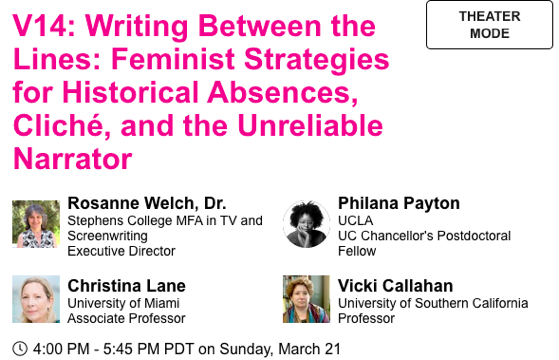
Nearly two years ago I had the pleasure of being invited to join a panel at the then upcoming SCMS (Society of Cinema and Media Studies) conference set for Seattle.  As you know that was canceled due to Covid with the hopes of reconvening in Colorado in 2021.  That became a virtual conference but our group decided to reapply our panel and we four were able to ‘meet’ on Zoom on Sunday and present:  Writing Between the Lines: Feminist Strategies for Historical Absences, Cliché, and the Unreliable Narrator. 

Here you can watch my part of the presentation,

“When Men Forget Women: The Many Ways Male Screenwriters Fail to Mention their Female Colleagues in Oral Histories”

Dr. Rosanne Welch Presents


Our intrepid panel leader, Christina Lane (author of Phantom Lady – the new biography of writer-producer Joan Harrison) kept us connected across the time.  Other panel participants included Philana Payton (UCLA) who is researching the memoirs of Eartha Kitt and Vicki Callahan (USC) who covered the career of Mabel Normand.  I was happy to highlight the many female screenwriters whose histories were left on the cutting room floor thanks to the unreliable narrators of their work who included directors, film reviewers, and husbands – all who left the female writers out of their own memories.


V14 Writing Between the Lines: Feminist Strategies for Historical Absences, Cliché, and the Unreliable Narrator

Chair: Christina Lane, University of Miami

Co-Chair: Vicki Callahan, University of Southern California

Vicki Callahan, University of Southern California, “Still Looking for Mabel Normand”
Philana Payton, University of Southern California, “Eartha Kitt vs. Eartha Mae: Black Women, Self-Fragmentation, and the Politics of Hollywood Stardom”
Rosanne Welch, Stephens College, “When Men Forget Women: The Many Ways Male Screenwriters Fail to Mention their Female Colleagues in Oral Histories”
Christina Lane, University of Miami, “Alternative Writing Strategies: Notes on Discovering the ‘Women Who Knew’ Joan Harrison”

Dr. Rosanne Welch Presents

Dr. Rosanne Welch and Intellect Editor James Campbell Talk The Journal of Screenwriting and Others – Instagram Live – Wed, March 24, 2021, 10am PDT

Dr. Rosanne Welch and Intellect Editor James Campbell Talk The Journal of Screenwriting and Others - Instagram Live - Wed, March 24, 2021, 10am PDT

JOIN US!

Instagram Live – Wed, March 24, 2021, 10am PDT

on the Intellect Instagram Account


I’ll be joining Intellect editor James Campbell this Wednesday the 24th for his Instagram Live segment. 

We’ll be discussing the Special Issue of the Journal of Screenwriting that I co-edited with Rose Ferrell which covered international Women in Screenwriting

We’ll also be talking about how and why to write for journals and how to use them in your courses.

Journal of Screenwriting Cover

04 The Comedy Writer’s Room from How The Chaos Of Collaboration in the Writers Room Created Golden Age Television [Video]

With the full recording of “How The Chaos Of Collaboration in the Writers Room Created Golden Age Television”

04 The Comedy Writer's Room from How The Chaos Of Collaboration in the Writers Room Created Golden Age Television [Video]

Subscribe to Rosanne’s Channel and receive notice of each new video!


When the folks hosting the conference announced their theme as “Screen Narratives: Chaos and Order” the word ‘chaos’ immediately brought to mind writers rooms. I offered a quick history of writers rooms (the presentations are only 20 minutes long) and then quoted several current showrunners on how they compose their rooms and how they run them.

Transcript

In terms of the history of writer’s rooms, comedy always sort of had them and we know that going back into the early days of the George Burns and Gracie Allen Show. He had a team of writers including his brother who worked with him. So comedy always knew that it needed a group. It was as if they knew the sitcom was an outgrowth of standup comedy or those vaudeville acts they had all been in. Of course, we love The Dick Van Dyke Show taught many people in America — many females in America — you could write for television because there was a female character writing of television, right, in the ’60s. So that taught us we had a place in this business which is a good thing. Neil Simon worked in early TV comedy shows and so he then glamourized that in his play so that’s a way that people learn about writer’s rooms. They see it operate and this was a room that included very famous men. Larry Gelbart who did M*A*S*H. Woody Allen who we can say other things about these days.

For more information on the Screenwriting Research Network, visit

Screenwriting Research Network Conference, Porto, Portugal, All Sessions


Ready to present my talk yesterday at the Screenwriting Research Conference here in Porto, Portugal via Instagram

Follow me on Instagram


* A portion of each sale from Amazon.com directly supports our blogs
** Many of these books may be available from your local library. Check it out!

Watch this presentation on “When Women Wrote Hollywood” for the Empire State Center for the Book [Video] (1 hour)

Event: When Women Wrote Hollywood presentation for the Empire State Center for the Book - Tuesday, March 9, 2021 – 7 pm EST

Watch this presentation on

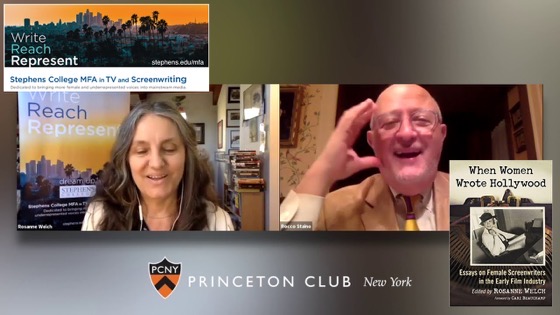
MFA Executive Director Dr. Rosanne Welch gave a Zoom presentation onWhen Women Wrote Hollywood for the Empire State Center for the Book, the New York State affiliate of the Library of Congress Center for the Book.

Dr. Welch discussed many highly successful female screenwriters of early Hollywood and explained why they don’t appear in most mainstream histories of the era.

The essays in this book were written by the alumni of the  inaugural class of the Stephens College MFA in TV and Screenwriting and come from the stories of the many brilliant female screenwriters studied in our History of Screenwriting courses and collected into When Women Wrote Hollywood.

Stephens College MFA In TV And Screenwriting Workshop

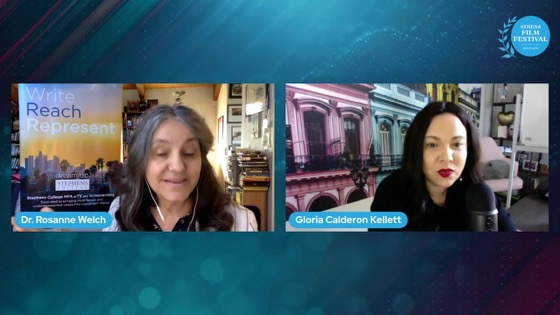
Dr. Rosanne Welch hosts a Master Class With Executive Producer/Showrunner Gloria Calderón Kellett — Athena Film Festival 2021

Each year, as a sponsor of the Athena Film Festival, the Stephens College MFA in TV and Screenwriting hosts a Master Class interview with a major television showrunner. 

For this year’s virtual festival, I had the privilege of interviewing Gloria Calderon Kellett, co-creator and executive producer of the beloved reboot of One Day at a Time.

 In our interview, Kellett shared how much she learned about running a show from her earliest days as a writer’s assistant, how earning an MFA was an investment in her future, and how much joy she’s had in using the power of her position to Write, Reach and Represent.

Dr. Rosanne Welch hosts a Master Class With Executive Producer/Showrunner Gloria Calderón Kellet -- Athena Film Festival 2021

Please enjoy this Master Class with Showrunner, writer, and actress Gloria Calderón Kellett.

Gloria Calderón Kellett is a Showrunner, writer, director, and actor best known for the critically acclaimed reboot ONE DAY AT A TIME. She is currently on a deal at Amazon Studios where she is developing new shows and movies.

Sponsored by Stephens College MFA Program on TV and Screenwriting


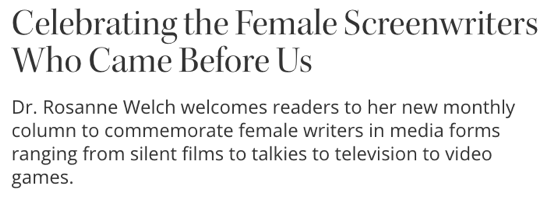
Celebrating the Female Screenwriters Who Came Before Us by Dr. Rosanne Welch — Script Magazine, March 2021

It seems quite appropriate that in March, the month we set aside to commemorate all the many marvelous contributions women have made in the arts, I’ve begun a monthly column for Script Magazine celebrating famous female screenwriters of the past.  The first column posted today. Come along and learn the names of the many wonderful women who wrote Hollywood. 

RMW Rosanne Signature for Web

Script magazine logo Rmw script 001

I’m pleased to begin this new column in March, the month we set aside to commemorate all the contributions women have made – and will continue to make – as writers in media forms ranging from silent films to talkies to television to video games.

People often ask me why I created a series of History of Screenwriting courses and not courses on the History Film. I tell them that the History of Film most often becomes the History of Directors which in turn becomes the History of Great Men and I am done with that version of history. I’m also done with the auteur theory that came from French film critics deciding directors were the ‘authors’ of the movies – a theory that has been disproven over and over again but still refuses to die. The word writer comes before director in the job title writer-director because when people talk about the film and TV shows they love they rarely recollect a director’s camera angles but they always quote the writer’s dialogue.

I spent my childhood in a suburb of Cleveland, Ohio, an only child who watched TV and read books so I could spend my summer days with newfound friends. I read every book about Hollywood I could find in my tiny local library. Most of them written by men but some, some precious few, were the memoirs of women who had written movies before and during the Golden Age: Anita Loos, Adela Rogers St. Johns, Dorothy Parker (who I only knew as a poet), Ruth Gordon (who I only knew as an actress), and many more who became my mentors. Yet when I went to college and studied film history (there wasn’t any TV history) I never found their names in the textbooks my professors assigned me. In fact, many of my (mostly male) professors had never heard these women’s names.=

I won’t let that happen to you. I firmly believe we need to know the names – and the bodies of work – of the women on whose shoulders we stand as we build our writing careers. Novelists study those who came before them. Screenwriters need to do the same. Women especially need to know the names of the women who founded filmmaking — and those who founded the Writers Guild to protect their interests — so that whenever some modern studio executive wonders whether they can risk big budgets when women writers aren’t usually given such power, the women can list off the names of all the women who came before them whose films made millions – and won Oscars – long before these (mostly male) studio executives were born.

Word matter. Writers matter. Women writers matter. Follow this column to learn not only their names but the themes of their work. Each month I’ll introduce you to women who took the lemons of love and loss in their lives and turned them into art that lasts across decades. Follow me and soon women like Anita Loos (Gentlemen Prefer Blondes), Jeanie Macpherson (Ten Commandments), Elinor Gwyn (It), Frances Goodrich (The Thin Man), and Dorothy Parker (A Star is Born) will be your friends and mentors, too.

Read Celebrating the Female Screenwriters Who Came Before Us on the Script web site
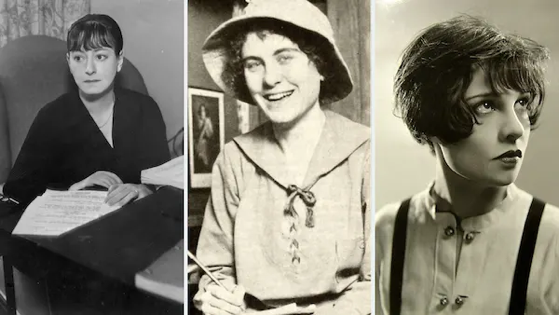
(L-R) Dorothy Parker, Jeanie Macpherson and Anita Loos

Rosanne presents to Oxford Brookes University Students in transatlantic creative education exchange

1200px Oxford Brookes University logo svg


Previous, on-site, presentation at Oxford Brookes

Thanks for our meeting at a Screenwriting Research Network conference almost 10 years ago Dr. Paolo Russo (of Oxford Brookes University) and I have been able to engage in a few transatlantic creative exchanges.

He’s come to speak on Italian Neo-realism to my MFA candidates and I had the pleasure of visiting with his masters candidates (in person! when that was still possible) and giving them notes on their drama series treatments. 

This week I’ll be doing that again on Zoom with the help of Shannon Dobson Fopeano, my Graduate Assistant in the Stephens College MFA in TV and Screenwriting.  Paolo and I are both interested in expanding the reach of this cross-ocean collegiality in the future!

Stephens College MFA In TV And Screenwriting Workshop


03 Managed Chaos from How The Chaos Of Collaboration in the Writers Room Created Golden Age Television [Video]

With the full recording of “How The Chaos Of Collaboration in the Writers Room Created Golden Age Television”

03 Manage Chaos from How The Chaos Of Collaboration in the Writers Room Created Golden Age Television [Video]

Subscribe to Rosanne’s Channel and receive notice of each new video!


When the folks hosting the conference announced their theme as “Screen Narratives: Chaos and Order” the word ‘chaos’ immediately brought to mind writers rooms. I offered a quick history of writers rooms (the presentations are only 20 minutes long) and then quoted several current showrunners on how they compose their rooms and how they run them.

Transcript

So that’s kind of my philosophy. I really don’t like the auteur theory and neither do a lot of other writers. This particular quote comes to us from the gentleman who gave us, in America, Breaking Bad, Vince Gilligan. So I want to talk about writer’s rooms and his is considered one of the most organized so perhaps the less chaotic but still what happens in the room has its own form of chaos. So I think it’s really interesting that he is willing to defend the idea that writers are more important than directors. He’s certainly got an Emmy to prove he’s an important writer but I appreciate very much what he had to say. The room is about making people as comfortable as possible and this can be a difficult task but it’s the task of the executive producer or the showrunner to make sure that the people in the room are open to sharing as many of their interesting ideas as possible right? So chaos but managed chaos. You have to allow for much conversation but you’re the one managing what’s being said so you don’t run off on a tangent and of course Vince was brilliant at that.

For more information on the Screenwriting Research Network, visit

Screenwriting Research Network Conference, Porto, Portugal, All Sessions


Ready to present my talk yesterday at the Screenwriting Research Conference here in Porto, Portugal via Instagram

Follow me on Instagram


* A portion of each sale from Amazon.com directly supports our blogs
** Many of these books may be available from your local library. Check it out!