Watch this presentation on “When Women Wrote Hollywood” for the Empire State Center for the Book [Video] (1 hour)

Event: When Women Wrote Hollywood presentation for the Empire State Center for the Book - Tuesday, March 9, 2021 – 7 pm EST

Watch this presentation on

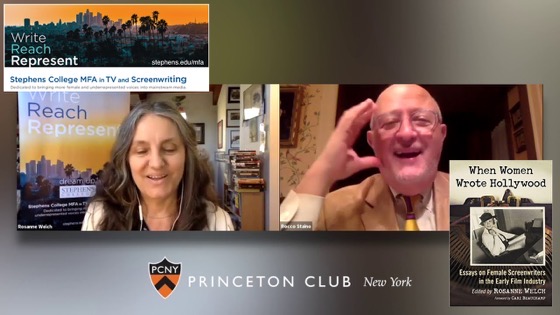
MFA Executive Director Dr. Rosanne Welch gave a Zoom presentation onWhen Women Wrote Hollywood for the Empire State Center for the Book, the New York State affiliate of the Library of Congress Center for the Book.

Dr. Welch discussed many highly successful female screenwriters of early Hollywood and explained why they don’t appear in most mainstream histories of the era.

The essays in this book were written by the alumni of the  inaugural class of the Stephens College MFA in TV and Screenwriting and come from the stories of the many brilliant female screenwriters studied in our History of Screenwriting courses and collected into When Women Wrote Hollywood.

Stephens College MFA In TV And Screenwriting Workshop

A Woman Wrote That – 19 in a series – You’ve Got Mail (1998), Writer: Nora Ephron

This new “A Woman Wrote That” post is an echo of the Writers Guild campaign of a few years ago (“A Writer Wrote That”) where they noted famous movie quotes and credited the screenwriter rather than the director.  The difference here being that we will be posting lines from films written by female screenwriters.  Feel free to share! — Rosanne

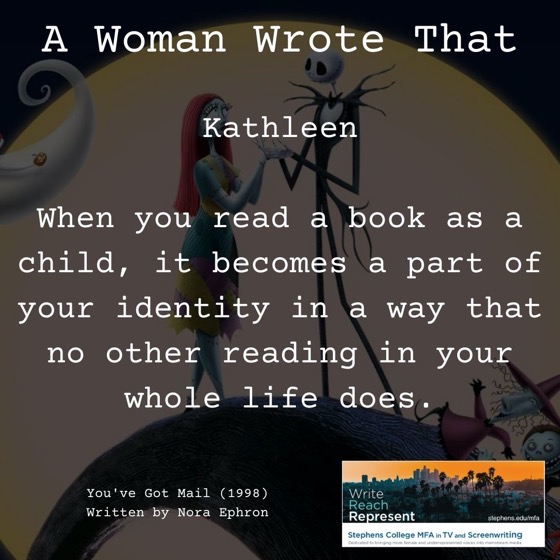
A Woman Wrote That - 19 in a series - You've Got Mail (1998), Writer: Nora Ephron

KATHLEEN

When you read a book as a child, it becomes a part of your identity in a way that no other reading in your whole life does.

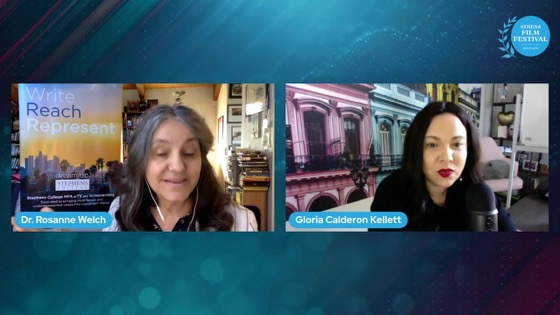
Dr. Rosanne Welch hosts a Master Class With Executive Producer/Showrunner Gloria Calderón Kellett — Athena Film Festival 2021

Each year, as a sponsor of the Athena Film Festival, the Stephens College MFA in TV and Screenwriting hosts a Master Class interview with a major television showrunner. 

For this year’s virtual festival, I had the privilege of interviewing Gloria Calderon Kellett, co-creator and executive producer of the beloved reboot of One Day at a Time.

 In our interview, Kellett shared how much she learned about running a show from her earliest days as a writer’s assistant, how earning an MFA was an investment in her future, and how much joy she’s had in using the power of her position to Write, Reach and Represent.

Dr. Rosanne Welch hosts a Master Class With Executive Producer/Showrunner Gloria Calderón Kellet -- Athena Film Festival 2021

Please enjoy this Master Class with Showrunner, writer, and actress Gloria Calderón Kellett.

Gloria Calderón Kellett is a Showrunner, writer, director, and actor best known for the critically acclaimed reboot ONE DAY AT A TIME. She is currently on a deal at Amazon Studios where she is developing new shows and movies.

Sponsored by Stephens College MFA Program on TV and Screenwriting


Where’s Her Movie? Actress, Maria Montez – 12 in a series

“Where’s HER Movie” posts will highlight interesting and accomplished women from a variety of professional backgrounds who deserve to have movies written about them as much as all the male scientists, authors, performers, and geniuses have had written about them across the over 100 years of film.  This is our attempt to help write these women back into mainstream history.  — Rosanne

Where's Her Movie? Actress, Maria Montez - 12 in a series

María África Gracia Vidal (6 June 1912 – 7 September 1951),(known as the “Queen Of The Technicolor” and “Maria Montez”) was a Dominican motion picture actress who gained fame and popularity in the 1940s as an exotic beauty starring in a series of filmed-in-Technicolor costume adventure films. Her screen image was that of a seductress, dressed in fanciful costumes and sparkling jewels. She became so identified with these adventure epics that she became known as “The Queen of Technicolor”. Over her career, Montez appeared in 26 films, 21 of which were made in North America and the last five were made in Europe. Wikipedia

Celebrating the Female Screenwriters Who Came Before Us by Dr. Rosanne Welch — Script Magazine, March 2021

It seems quite appropriate that in March, the month we set aside to commemorate all the many marvelous contributions women have made in the arts, I’ve begun a monthly column for Script Magazine celebrating famous female screenwriters of the past.  The first column posted today. Come along and learn the names of the many wonderful women who wrote Hollywood. 

RMW Rosanne Signature for Web

Script magazine logo Rmw script 001

I’m pleased to begin this new column in March, the month we set aside to commemorate all the contributions women have made – and will continue to make – as writers in media forms ranging from silent films to talkies to television to video games.

People often ask me why I created a series of History of Screenwriting courses and not courses on the History Film. I tell them that the History of Film most often becomes the History of Directors which in turn becomes the History of Great Men and I am done with that version of history. I’m also done with the auteur theory that came from French film critics deciding directors were the ‘authors’ of the movies – a theory that has been disproven over and over again but still refuses to die. The word writer comes before director in the job title writer-director because when people talk about the film and TV shows they love they rarely recollect a director’s camera angles but they always quote the writer’s dialogue.

I spent my childhood in a suburb of Cleveland, Ohio, an only child who watched TV and read books so I could spend my summer days with newfound friends. I read every book about Hollywood I could find in my tiny local library. Most of them written by men but some, some precious few, were the memoirs of women who had written movies before and during the Golden Age: Anita Loos, Adela Rogers St. Johns, Dorothy Parker (who I only knew as a poet), Ruth Gordon (who I only knew as an actress), and many more who became my mentors. Yet when I went to college and studied film history (there wasn’t any TV history) I never found their names in the textbooks my professors assigned me. In fact, many of my (mostly male) professors had never heard these women’s names.=

I won’t let that happen to you. I firmly believe we need to know the names – and the bodies of work – of the women on whose shoulders we stand as we build our writing careers. Novelists study those who came before them. Screenwriters need to do the same. Women especially need to know the names of the women who founded filmmaking — and those who founded the Writers Guild to protect their interests — so that whenever some modern studio executive wonders whether they can risk big budgets when women writers aren’t usually given such power, the women can list off the names of all the women who came before them whose films made millions – and won Oscars – long before these (mostly male) studio executives were born.

Word matter. Writers matter. Women writers matter. Follow this column to learn not only their names but the themes of their work. Each month I’ll introduce you to women who took the lemons of love and loss in their lives and turned them into art that lasts across decades. Follow me and soon women like Anita Loos (Gentlemen Prefer Blondes), Jeanie Macpherson (Ten Commandments), Elinor Gwyn (It), Frances Goodrich (The Thin Man), and Dorothy Parker (A Star is Born) will be your friends and mentors, too.

Read Celebrating the Female Screenwriters Who Came Before Us on the Script web site
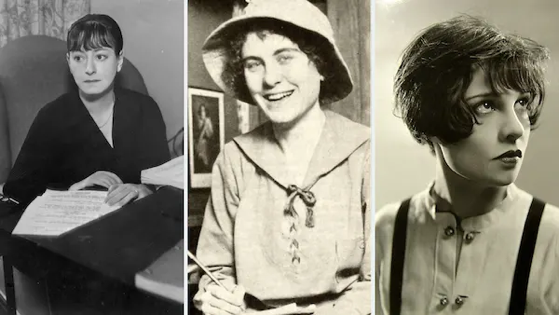
(L-R) Dorothy Parker, Jeanie Macpherson and Anita Loos

From The Journal Of Screenwriting V4 Issue 2: Tracing the voice of the auteur: Persona and the Ingmar Bergman Archive by Anna Sofia Rossholm

Highlighting the articles in the past editions of the Journal of Screenwriting, of which I am the Book Reviews Editor. Hopefully these abstracts will entice you to did a little deeper into the history and future of screenwriting. — Rosanne


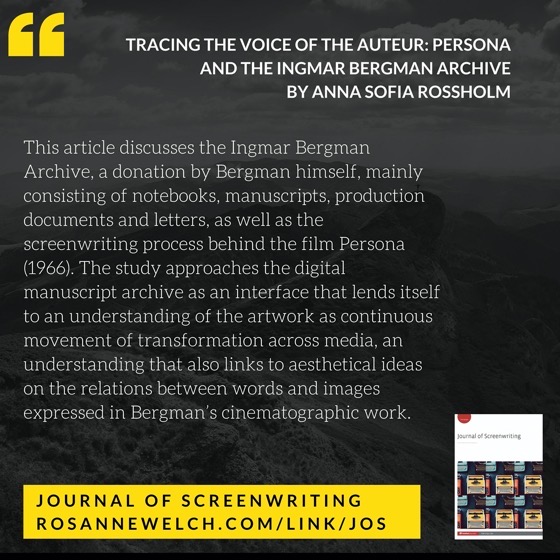
Tracing the voice of the auteur: Persona and the Ingmar Bergman Archive by Anna Sofia Rossholm

This article discusses the Ingmar Bergman Archive, a donation by Bergman himself, mainly consisting of notebooks, manuscripts, production documents and letters, as well as the screenwriting process behind the film Persona (1966). The study approaches the digital manuscript archive as an interface that lends itself to an understanding of the artwork as continuous movement of transformation across media, an understanding that also links to aesthetical ideas on the relations between words and images expressed in Bergman’s cinematographic work. The study opens with a discussion of these issues and continues with a reading of the self-reflexive film Persona in order to examine how the explicit reflections on the mediation are negotiated across notebook drafts and scripts. The different phases in the process of creation – from notes and drafts to script versions and film – reflect on the transitory nature of the text as well as drawing on the specificities of each form of expression.

From The Journal Of Screenwriting V4 Issue 2: Tracing the voice of the auteur: Persona and the Ingmar Bergman Archive by Anna Sofia Rossholm


Journal of Screenwriting Cover

The Journal of Screenwriting is an international double-blind peer-reviewed journal that is published three times a year. The journal highlights current academic and professional thinking about the screenplay and intends to promote, stimulate and bring together current research and contemporary debates around the screenplay whilst encouraging groundbreaking research in an international arena. The journal is discursive, critical, rigorous and engages with issues in a dynamic and developing field, linking academic theory to screenwriting practice. 

Get your copy and subscription to the Journal of Screenwriting Today!


* A portion of each sale from Amazon.com directly supports our blogs
** Many of these books may be available from your local library. Check it out!

The Civil War On Film – 22 in a series – “…but allowed filmmakers to avoid the contentious issue of slavery.”

The Civil War On Film - 22 in a series -

In the decades before World War II, Civil War films were largely set in the Eastern theater, but as the center for movie making shifted west to California and studios built permanent western sets (so as to make a great number of inexpensive western films), filmmakers began combining the two film genres. The innovation not only expanded the kind of movie stories that could be told, but allowed filmmakers to avoid the contentious issue of slavery.

Movies profiled in this book:

Rosanne presents to Oxford Brookes University Students in transatlantic creative education exchange

1200px Oxford Brookes University logo svg


Previous, on-site, presentation at Oxford Brookes

Thanks for our meeting at a Screenwriting Research Network conference almost 10 years ago Dr. Paolo Russo (of Oxford Brookes University) and I have been able to engage in a few transatlantic creative exchanges.

He’s come to speak on Italian Neo-realism to my MFA candidates and I had the pleasure of visiting with his masters candidates (in person! when that was still possible) and giving them notes on their drama series treatments. 

This week I’ll be doing that again on Zoom with the help of Shannon Dobson Fopeano, my Graduate Assistant in the Stephens College MFA in TV and Screenwriting.  Paolo and I are both interested in expanding the reach of this cross-ocean collegiality in the future!

Stephens College MFA In TV And Screenwriting Workshop


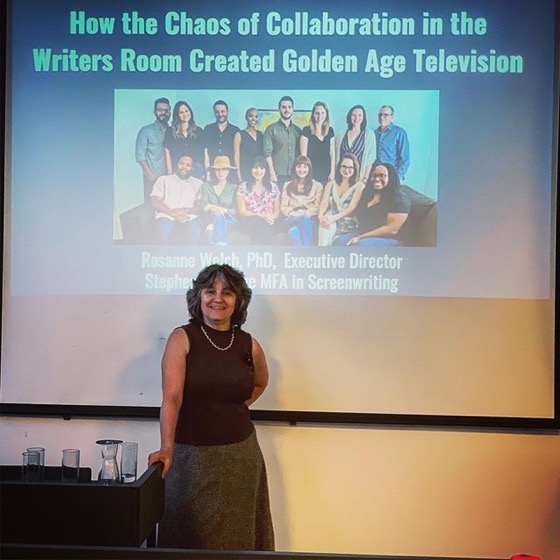
03 Managed Chaos from How The Chaos Of Collaboration in the Writers Room Created Golden Age Television [Video]

With the full recording of “How The Chaos Of Collaboration in the Writers Room Created Golden Age Television”

03 Manage Chaos from How The Chaos Of Collaboration in the Writers Room Created Golden Age Television [Video]

Subscribe to Rosanne’s Channel and receive notice of each new video!


When the folks hosting the conference announced their theme as “Screen Narratives: Chaos and Order” the word ‘chaos’ immediately brought to mind writers rooms. I offered a quick history of writers rooms (the presentations are only 20 minutes long) and then quoted several current showrunners on how they compose their rooms and how they run them.

Transcript

So that’s kind of my philosophy. I really don’t like the auteur theory and neither do a lot of other writers. This particular quote comes to us from the gentleman who gave us, in America, Breaking Bad, Vince Gilligan. So I want to talk about writer’s rooms and his is considered one of the most organized so perhaps the less chaotic but still what happens in the room has its own form of chaos. So I think it’s really interesting that he is willing to defend the idea that writers are more important than directors. He’s certainly got an Emmy to prove he’s an important writer but I appreciate very much what he had to say. The room is about making people as comfortable as possible and this can be a difficult task but it’s the task of the executive producer or the showrunner to make sure that the people in the room are open to sharing as many of their interesting ideas as possible right? So chaos but managed chaos. You have to allow for much conversation but you’re the one managing what’s being said so you don’t run off on a tangent and of course Vince was brilliant at that.

For more information on the Screenwriting Research Network, visit

Screenwriting Research Network Conference, Porto, Portugal, All Sessions


Ready to present my talk yesterday at the Screenwriting Research Conference here in Porto, Portugal via Instagram

Follow me on Instagram


* A portion of each sale from Amazon.com directly supports our blogs
** Many of these books may be available from your local library. Check it out!

A Woman Wrote That – 18 in a series – The Nightmare Before Christmas (1993), Writer: Caroline Thompson

This new “A Woman Wrote That” post is an echo of the Writers Guild campaign of a few years ago (“A Writer Wrote That”) where they noted famous movie quotes and credited the screenwriter rather than the director.  The difference here being that we will be posting lines from films written by female screenwriters.  Feel free to share! — Rosanne

A Woman Wrote That - 18 in a series - The Nightmare Before Christmas (1993), Writer: Caroline Thompson

MAYOR

Jack, please, I’m only an elected official here. I can’t make decisions by myself.