Highlighting the articles in the past editions of the Journal of Screenwriting, of which I am the Book Reviews Editor. Hopefully these abstracts will entice you to did a little deeper into the history and future of screenwriting. — Rosanne
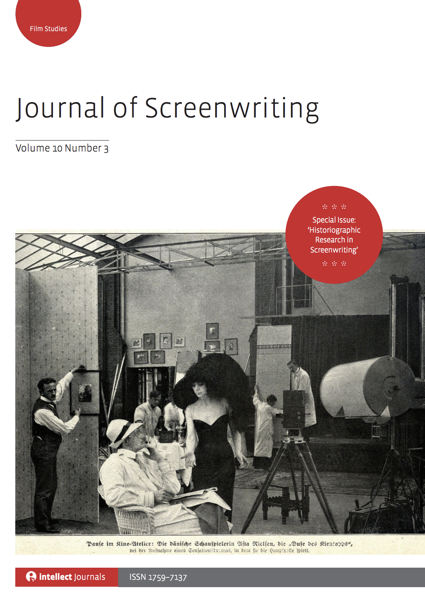
In the film Passion (1982) and its video scenario, Scénario du film Passion (1982), Jean-Luc Godard attempts to re-envision the conventional script by placing an emphasis on visual rather than verbal forms. In this article, I examine Godard’s development of narrative through image in Passion and his description of this process in Scénario du film Passion. In addition, I consider the concurrent emphasis he places on the visualization of narrative in the diegetic film around which the storyline of Passion is based. To contextualize the process of narrative construction that Godard applies in the films considered in the article, I present some earlier examples of his screenwriting practice that illustrate how Godard’s screenwriting evolved towards an image-based approach.
The Journal of Screenwriting is an international double-blind peer-reviewed journal that is published three times a year. The journal highlights current academic and professional thinking about the screenplay and intends to promote, stimulate and bring together current research and contemporary debates around the screenplay whilst encouraging groundbreaking research in an international arena. The journal is discursive, critical, rigorous and engages with issues in a dynamic and developing field, linking academic theory to screenwriting practice.
“Where’s HER Movie” posts will highlight interesting and accomplished women from a variety of professional backgrounds who deserve to have movies written about them as much as all the male scientists, authors, performers, and geniuses have had written about them across the over 100 years of film. This is our attempt to help write these women back into mainstream history. — Rosanne
“It was well recognized that Martha Raye endured less comfort and more danger than any other Vietnam entertainer. Don’t let the sun go down without reading this about Martha Raye.
The most unforgivable oversight of TV is that her shows were not taped. I was unaware of her credentials or where she is buried. Somehow I just can’t see Brittany Spears, Paris Hilton, or Jessica Simpson doing what this woman (and the other USO women, including Ann Margaret & Joey Heatherton) did for our troops in past wars. Most of the old time entertainers were made of a lot sterner stuff than today’s crop of activists bland whiners.
The following is from an Army Aviator who takes a trip down memory lane:
“It was just before Thanksgiving ’67 and we were ferrying dead and wounded from a large GRF west of Pleiku. We had run out of body bags by noon, so the Hook (CH-47 CHINOOK) was pretty rough in the back. All of a sudden, we heard a ‘take-charge’ woman’s voice in the rear. There was the singer and actress, Martha Raye, with a SF (Special Forces) beret and jungle fatigues, with subdued markings, helping the wounded into the Chinook, and carrying the dead aboard. ‘Maggie’ had been visiting her SF ‘heroes’ out ‘west’. We took off, short of fuel, and headed to the USAF hospital pad at Pleiku. As we all started unloading our sad pax’s, a ‘Smart Mouth’ USAF Captain said to Martha…. “Ms Ray, with all these dead and wounded to process, there would not be time for your show!” To all of our surprise, she pulled on her right collar and said ……”Captain, see this eagle? I am a full ‘Bird’ in the US Army Reserve, and on this is a ‘Caduceus’ which means I am a Nurse, with a surgical specialty….now, take me to your wounded!” He said, “Yes ma’am…. follow me.” Several times at the Army Field Hospital in Pleiku, she would ‘cover’ a surgical shift, giving a nurse a well-deserved break. Martha is the only woman buried in the SF (Special Forces) cemetery at Ft Bragg. Hand Salute! A great lady.. I did not know this about Martha Ray…. thought you might like it.”
Subscribe to Rosanne’s Channel and receive notice of each new video!
Transcript:
One of my favorite examples of how important it is to see culture travel through these streaming services is the film — it’s called Coco in the United States. It’s called Vivo here. When my cousins — my cousins are from Sicily — my grandparents immigrated to the United States from Sicily and their relatives stayed behind. So I’m related and connected to third and fourth cousins who live there. They came to visit me at Christmas this year and we were discussing Halloween, which I laughed at because I noticed some Halloween decorations in places I traveled around town today, and my cousin said in Italy Halloween is not very important because of course being a Catholic country what is important is that this is the Day of All Souls and so it’s a religious holiday. Only in you know only in Italy is that important and I said oh haven’t you ever heard of the Day of the Dead in Mexico and she had not because in Italy they haven’t studied Mexican culture. So I mentioned this movie which she had never seen but her 10-year-old son had seen it. The problem was on Netflix it was only running in English or Spanish and they’re Italian but their 10-year-old is studying Spanish in school. So at my house, we turned on Netflix. We watched the movie in Spanish with English subtitles to remind me because I’d seen it but I wanted to remember the story and any time the Italians lost track of this Spanish language we would pause and the ten-year-old would translate the Spanish into Italian and we’d all catch up and continue and in that way, they learned the story of the Day of the Dead — Dia de Los Muertos through this movie and they were so moved by the theme of the movie which again is such a universal theme that we should honor our ancestors and that we owe it to them right to live up to their history. It was a beautiful example of what Netflix is capable of doing — what streaming services are capable of doing for us and how important story is.
Watch this entire presentation
A Note About This Presentation
A clip from my keynote speech at the 10th Screenwriters´(hi)Stories Seminar for the interdisciplinary Graduation Program in “Education, Art, and History of Culture”, in Mackenzie Presbyterian University, at São Paulo, SP, Brazil, focused on the topic “Why Researching Screenwriters (has Always) Mattered.” I was especially pleased with the passion these young scholars have toward screenwriting and it’s importance in transmitting culture across the man-made borders of our world.
To understand the world we have to understand its stories and to understand the world’s stories we must understand the world’s storytellers. A century ago and longer those people would have been the novelists of any particular country but since the invention of film, the storytellers who reach the most people with their ideas and their lessons have been the screenwriters. My teaching philosophy is that: Words matter, Writers matter, and Women writers matte, r so women writers are my focus because they have been the far less researched and yet they are over half the population. We cannot tell the stories of the people until we know what stories the mothers have passed down to their children. Those are the stories that last. Now is the time to research screenwriters of all cultures and the stories they tell because people are finally recognizing the work of writers and appreciating how their favorite stories took shape on the page long before they were cast, or filmed, or edited. But also because streaming services make the stories of many cultures now available to a much wider world than ever before.
Many thanks to Glaucia Davino for the invitation.
* A portion of each sale from Amazon.com directly supports our blogs ** Many of these books may be available from your local library. Check it out! † Available from the LA Public Library
Described as the story of “an adorable tow truck driver who really digs Kelli, a fellow North Carolinian, when he meets her as he changes her dead car battery. But Joe’s interest takes a sharp right turn when he learns that Kelli is a Muslim” the film raised questions of identity, representation and religious freedom.
For the panel, Executive Director Rosanne Welch and mentor/instructor Dawn Comer Jefferson provided a breakdown of the script followed by moderating questions from the audience. Guests included Nicole Ballivian (writer-director), Deonna Kelli Sayed, from whose blog post the script was adapted, and actors Jill Galbraith and Travis Lincoln Cox. — Rosanne
Subscribe to Rosanne’s Channel and receive notice of each new video!
Transcript:
A perfect example of taking horror and blending in social commentary right and putting those together so the horror is that one extra level above what you thought it could be right and that’s what makes it stand out. That’s what makes it Oscar-worthy right? He’s doing exactly what Toni Morrison did but doing it in a film. He’s still talking about the horror of slavery and what it meant to this country in a whole different type of story which I think is really cool. I think it’s cool because all of this is coming full circle now as Netflix is about excuse me CW is about to open a new show called The Shelley Society about Mary Shelley and all her buddies who battled monsters back in their own day which sounds an awful lot like a redo of Buffy, just with a famous character in it right? I think that’s going to be really fascinating. I really want that to work. It’s being done by the gentleman who’s doing Riverdale, which is taking the Archie comics and readapting them. I think that’s pretty cool.
A Note About This Presentation
A clip from my keynote speech at the 10th Screenwriters´(hi)Stories Seminar for the interdisciplinary Graduation Program in “Education, Art, and History of Culture”, in Mackenzie Presbyterian University, at São Paulo, SP, Brazil, focused on the topic “Why Researching Screenwriters (has Always) Mattered.” I was especially pleased with the passion these young scholars have toward screenwriting and it’s importance in transmitting culture across the man-made borders of our world.
To understand the world we have to understand its stories and to understand the world’s stories we must understand the world’s storytellers. A century ago and longer those people would have been the novelists of any particular country but since the invention of film, the storytellers who reach the most people with their ideas and their lessons have been the screenwriters. My teaching philosophy is that: Words matter, Writers matter, and Women writers matte, r so women writers are my focus because they have been the far less researched and yet they are over half the population. We cannot tell the stories of the people until we know what stories the mothers have passed down to their children. Those are the stories that last. Now is the time to research screenwriters of all cultures and the stories they tell because people are finally recognizing the work of writers and appreciating how their favorite stories took shape on the page long before they were cast, or filmed, or edited. But also because streaming services make the stories of many cultures now available to a much wider world than ever before.
Many thanks to Glaucia Davino for the invitation.
* A portion of each sale from Amazon.com directly supports our blogs ** Many of these books may be available from your local library. Check it out! † Available from the LA Public Library
Highlighting the articles in the past editions of the Journal of Screenwriting, of which I am the Book Reviews Editor. Hopefully these abstracts will entice you to did a little deeper into the history and future of screenwriting. — Rosanne
An edited extract from a keynote address at the third Screenwriting Research Network conference, ‘Screenwriting Research: History, Theory and Practice’, at the University of Copenhagen in 2010,1 this piece focuses on what I have termed the ‘object problem’ in screenwriting research. I pay specific attention to how we might address the object problem by thinking about different attitudes and trajectories in screenwriting research.
The Journal of Screenwriting is an international double-blind peer-reviewed journal that is published three times a year. The journal highlights current academic and professional thinking about the screenplay and intends to promote, stimulate and bring together current research and contemporary debates around the screenplay whilst encouraging groundbreaking research in an international arena. The journal is discursive, critical, rigorous and engages with issues in a dynamic and developing field, linking academic theory to screenwriting practice.
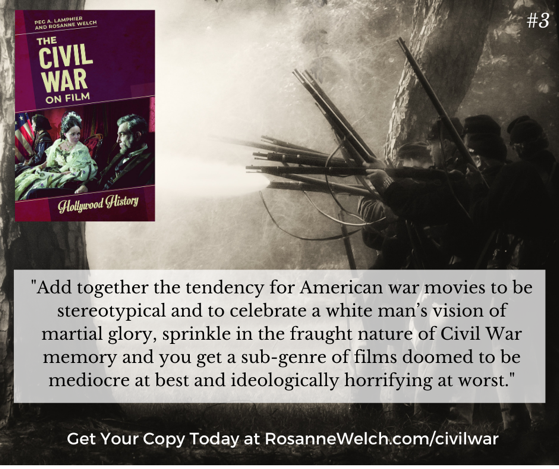
“Add together the tendency for American war movies to be stereotypical and to celebrate a white man’s vision of martial glory, sprinkle in the fraught nature of Civil War memory and you get a sub-genre of films doomed to be mediocre at best and ideologically horrifying at worst.”
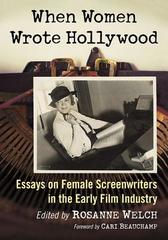
The reviewer (from the University College of North Manitoba, Canada) singled out several chapters for being outstanding for various reasons. They found Amelia Phillips’s chapter on Jeanne Macpherson to demonstrate “exacting research”, Julie Berkobien’s chapter on Francis and Albert Hackett to be “beautifully crafted” and Chase Thompson’s chapter on Lois Weber to be “trailblazing”. They found that Pamela Scott gives “thorough and measured” coverage to the scripts of Sarah Y. Mason and Victor Heerman; Laura Kirk “comprehensively” examines Sam and Bella Spewak’s signature style; Kelly Zinge authored “carefully detailed discussion” of Lillian Hellman’s confrontation with the Blacklist, and that Elizabeth Dwyer’s work on Dorothy Parker is “riveting.”
Congratulations to all the contributors to our book!
* A portion of each sale from Amazon.com directly supports our blogs
** Many of these books may be available from your local library. Check it out!
† Available from the LA Public Library
A fishwife tells her young daughter a fairy story about a princess imprisoned by a hunchback in a seashell, a story that parallels her own life. – IMDB
* A portion of each sale from Amazon.com directly supports our blogs
** Many of these books may be available from your local library. Check it out!
† Available from the LA Public Library


![34 Coco and Exposure To Different Cultures from Why Researching Screenwriters Has Always Mattered [Video] (2 mins)](https://rosannewelch.com/wp-content/uploads/2020/11/rmw-sao-paolo-34.png)
![Reel Sisters Virtual Film Festival and Lecture Series 2020 – Dr. Rosanne Welch and Dawn Comer Jefferson Analyze The Script, Joe & The Shawl [Video] (1 hour 42 minutes)](https://rosannewelch.com/wp-content/uploads/2020/11/reel-sisters-2020.png)
![34 More on Get Out from When Women Write Horror with Dr. Rosanne Welch [Video] (1 minute)](https://rosannewelch.com/wp-content/uploads/2020/10/rmw-cpp-horror-34.png)